

Learning how to start a tech startup the right way is essential if you want to increase your odds of building something real and sustainable. This guide gives you a modern, step-by-step system you can follow from idea to validation to MVP to first customers to product-market fit. It also functions as a startup checklist you can bookmark and revisit as you progress.
How to use this guide: Pick the phase you are in, follow the checklist, and do not skip ahead. Most founders fail because they build too early, choose the wrong customer, or never solve distribution.
Jump to your phase: Read straight through, or jump to the phase that matches your current stage: Founder Readiness, Validate the Problem, Define the Business, Build the MVP, Legal and Company Setup, Get First Customers, Improve and Find Product Market Fit.
Introduction
Starting a tech startup is not about having a clever idea. It is about solving a painful problem for a specific customer in a way that creates repeatable demand, and doing it with the discipline to validate before you overbuild. This guide is designed to help you avoid costly mistakes, reduce overwhelm, and move in the right order.
Many tech startups fail because they build something the market does not need, cannot acquire customers efficiently, or run out of runway before finding traction. That is why this guide prioritizes validation, clarity, and execution cadence over hype.
Reality check: Your life is more valuable than a startup idea. If an idea does not validate, that is not failure. That is saved time, saved money, and a smarter path forward.
If you are new to startups and want a deeper framework for validating ideas step by step, review our guide on How to Validate a Startup Idea. If you want guided structure, templates, and an end-to-end system, you can also explore our online startup incubator program.
This startup glossary will also help you with the terminology so you don’t feel lost.
At a Glance: The Startup Operating Path
Instead of treating tech startup creation like 30 equal steps, this guide is organized into phases. Each phase has one job and a few concrete outputs that prove you are ready to move on.
- Phase 0: Founder Readiness Build clarity on your constraints and strengths.
- Phase 1: Validate the Problem Prove a real pain exists and people want it solved.
- Phase 2: Define the Business Lock your customer, value proposition, and model.
- Phase 3: Build the MVP Build the smallest product that tests your hypothesis.
- Phase 3.5: Legal & Company Setup Legalize only when it matters and reduces risk.
- Phase 4: Get First Customers Start distribution, onboarding, and early revenue.
- Phase 5: Improve, Monetize, & Find Product Market Fit Iterate with data and retention signals.
Do not skip Phase 1. Building before validation is one of the most expensive founder mistakes because it creates months of work with no demand proof.
Phase 0: Founder Readiness
Constraints, Strengths, Weaknesses, and Stamina.
Most startup advice assumes founders have unlimited time, money, and energy. Real founders do not. Your constraints shape your strategy. Before you pick a market or commit to building, define your realistic inputs so your plan is survivable.
Step 1: Assess Your Passion and Expertise
Assess your ability to solve the problem and your willingness to stay committed for years. Passion does not replace strategy, but it does affect endurance. If you are not genuinely interested in the space, you will struggle through inevitable setbacks.
Expertise in your target market is strongly preferred because it reduces the learning curve and increases the quality of your early decisions. If your expertise is low, you can still succeed, but you must account for the ramp-up time and treat learning as a core part of the plan.
Quick test: Can you clearly describe the customer’s daily reality, their top pain points, and the moment they decide to search for a solution? If not, you are likely not close enough to the problem yet.
Step 2: Determine How Much Time You Can Devote
Most founders should keep their job while validating their idea. Determine your weekly time budget and make sure your startup plan fits it. Your first goal is not building a large product. Your first goal is proving demand.
- Define your weekly hours and your protected time blocks.
- Clarify your role and what you can realistically do yourself.
- If you have co-founders, clarify their hours, stability, and expectations.
- Double or triple timelines. Projects take longer than expected.
Do not quit your job just because you are excited. Quit when you have validation, a clear plan, and a runway that protects your life and relationships.
Step 3: Set Your Risk and Runway Rules
Define the rules that protect you from spiraling financially or emotionally. Most founders fail because they run out of runway before they reach traction. Your plan needs to be survivable for the length of time it takes to learn what works.
- Define your monthly personal expenses and the minimum runway you need.
- Decide your maximum monthly startup spend during validation.
- Define your “stop rules” if the idea does not validate by a deadline.
- Define your “continue rules” if you get strong validation signals.
Rule of thumb: If you cannot sustain your lifestyle while validating, you will pressure the startup to succeed too fast, which leads to rushed decisions and burnout.
Phase 1: Validate the Problem
Prove that a Real Customer Pain Exists and People Want a Solution.
One of the most crucial founder mistakes is skipping validation and building a product nobody wants. A large portion of tech startup failures comes down to lack of market need. That is why you validate first, then build second.
If you want a full walkthrough, start here: How to Validate a Startup Idea.
Step 4: Define the Problem and Hypothesis
Write your idea as a hypothesis you can test. A hypothesis is specific and falsifiable. If it is vague, you will not know what to test or what “success” looks like.
- Customer: Who is experiencing the problem?
- Pain: What exact pain are they experiencing?
- Trigger: What event causes them to actively look for a solution?
- Current alternatives: How do they solve it today?
- Outcome: What result do they actually want?
Step 5: Conduct Customer Interviews
Your goal is to learn the customer’s world, not to pitch. Great interviews surface real pain, urgency, and willingness to change behavior. Ask about past behavior and real situations, not hypothetical opinions.
- Interview people who actually match your target customer.
- Ask about the last time the problem happened and what it cost them.
- Ask what they tried, why it failed, and what would make them switch.
- Look for patterns across interviews, not one-off comments.
Red flag: If the problem is described as “nice to have,” “interesting,” or “maybe someday,” you likely do not have urgent pain.
Step 6: Validate Demand Signals
Validation is not vibes. It is evidence. Your goal is to collect strong signals that people want a solution and are willing to take action.
- People ask to be notified when it exists.
- People agree to a pilot, trial, or paid test.
- People introduce you to others with the same problem.
- People describe the problem as frequent and costly.
If you are not seeing these signals, do not rush into building. Iterate the target customer, the pain focus, or the solution concept and interview again.
Phase 2: Define the Business
Lock in your Ideal Customer Profile, your Promise, and your Monetization Hypothesis.
Once you have strong problem validation, define what you are building and how it becomes a business. This is where you translate customer reality into positioning, a value proposition, and a plan to monetize.
Step 7: Build Customer Profiles and Buyer Personas
Define your ideal customer in a way that helps you acquire them and serve them. Your customer profile should answer who they are, what they do, what they care about, and what triggers buying behavior.
Use this guide for a deeper walkthrough: How to Build Customer Profiles and Buyer Personas.
- Role, context, and responsibilities
- Top pain points and top desired outcomes
- Triggers that cause them to search for a solution
- Current solutions and switching costs
- Where they gather and how they discover tools
Step 8: Create Your Value Proposition and Unique Selling Proposition
A value proposition explains the specific value you provide and the problem you solve. A unique selling proposition clarifies why your approach is meaningfully different from alternatives.
- Write the customer’s pain in their own words.
- Write the outcome they want, not your feature list.
- Define what you do better than the status quo and competitors.
- Keep it simple enough that it can be repeated verbatim.
High leverage tip: If you cannot explain your value proposition in one clear sentence, your marketing will be expensive and your product will drift.
Step 9: Market Research
Market research helps you confirm your market size, trends, buyer behavior, and economic reality. It strengthens your executive summary, pitch deck, content strategy, and go-to-market plan.
If you plan to fundraise or want a crisp strategic snapshot, this guide helps: How to Write a Great Executive Summary.
- Define your target segment and market size range.
- Identify trends, tailwinds, and “why now?” factors.
- Identify buyer behavior and budget patterns if possible.
- Document assumptions so you can revise them later.
Step 10: Competitive Analysis
Competitive analysis is not just “who else exists.” It is understanding alternatives, positioning, and why customers choose what they choose. Your true competitor is often the status quo.
- Direct competitors: same customer, same solution type.
- Indirect competitors: same customer, different solution type.
- Status quo: spreadsheets, internal processes, “doing nothing.”
- Switching costs: why people stay with what they have.
If the market is crowded and you cannot articulate a meaningful differentiator, do not rush forward. Either niche down, reposition, or change the angle of the problem you solve.
Step 11: Create Your Business Model and Pricing Hypothesis
You do not need a complex financial model to start, but you do need a monetization hypothesis. How will you make money, what will you charge, and what does “sustainable” look like?
- Define pricing range assumptions and why they make sense.
- Estimate costs and your realistic margin targets.
- Define your conversion assumptions and retention assumptions.
- Track what must be true for the business to work.
For more detail on business models, review: 10 Major B2B and B2C Startup Business Models.
Phase 3: Build the MVP
Build the Smallest Product that Tests your Hypothesis and Proves Demand.
An MVP is not a stripped-down version of your dream product. It is a learning machine. It exists to test the most important assumptions with the least amount of time, money, and complexity.
For a deeper walkthrough, review: How to Build a Minimum Viable Product.
Step 12: Define Your MVP Scope
Start by defining what your MVP must prove. Then only build what is necessary to prove it. Your MVP should focus on one core customer, one core problem, and one core action.
- Write the main hypothesis your MVP must test.
- Define the single core outcome the user must achieve.
- Remove any feature that does not support that outcome.
- Plan a simple onboarding flow that gets users to the outcome fast.
MVP mistake: Building a “complete” product before you can reliably acquire and activate users is the fastest way to waste months.
Step 13: Determine How You Will Build It
Decide whether you will build it yourself, use no-code, hire contractors, work with an agency, or find a co-founder. Your build strategy should match your budget, timeline, and risk tolerance.
Advantages If You Are Technical
If you can build, your leverage is high, but do not neglect distribution. Many technical founders overbuild and under-market. Treat acquisition as a core skill, not an afterthought.
What To Do If You Are Non-Technical
You can still launch by using no-code tools, prototypes, manual fulfillment, or by hiring talent. If you want a guide to finding a co-founder, see: How to Find a Co-Founder and What to Look For.
If you want to hire talent, this guide can help: 13 Best Freelance Websites to Hire Top Talent.
Step 14: Set Up Measurement Early
You cannot improve what you do not measure. Set up basic analytics and conversion tracking early so you can learn what is working. Keep measurement focused on activation and retention, not vanity metrics.
- Track signups, activation, and the key action that represents value.
- Track where users came from and what they did next.
- Track conversion rates on your landing page and onboarding flow.
- Track retention signals such as returning usage and completion rates.
If you want a KPI overview with examples, see: 34 Key Performance Indicators to Measure Your Startup.
Phase 3.5: Legal and Company Setup
Legalize and operationalize the startup only when it reduces risk and supports traction.
Incorporation and legal setup are important, but many founders do them too early and create unnecessary admin burden. The right time to legalize is when it enables you to safely take payments, sign agreements, issue equity, and protect the work being created.
Incorporate now if: you are taking payments, signing contracts, bringing on co-founders with equity, hiring contractors, building meaningful IP, or planning to raise money.
Wait if: you are still validating and have no traction signals yet, you are not taking money, and the direction is still unclear.
Step 15: Choose the Right Legal Path for Your Goals
Entity choice depends on your goals. Bootstrapped businesses often choose different paths than venture-backed startups. If you plan to raise institutional money, founders often consider a Delaware C-Corp. If you are bootstrapping and validating, an LLC may be simpler early on. Talk to a qualified professional for advice based on your situation.
Step 16: Use Trusted Startup Formation Resources
Here are startup-friendly resources that can help you handle formation and documentation. These are tools and services, not a substitute for legal advice.
- Clerky for startup formation and fundraising docs.
- Stripe Atlas for a formation package geared toward internet businesses.
- Cooley GO for free startup legal resources and documents.
- Gust Launch for ongoing formation and admin support.
- LegalZoom as a general option, but confirm it fits your startup needs.
Step 17: Handle the Minimum Operational Setup
Once you legalize, set up the basics so you can operate cleanly and avoid future cleanup.
- Business bank account
- Basic bookkeeping and expense tracking
- Contracts for contractors and service providers
- IP assignment and founder documentation if applicable
- Privacy policy and terms if you collect user data
Phase 4: Get First Customers
Distribution, Onboarding, Activation, and Getting the First Repeatable Wins.
The best product does not win. The product with distribution wins. Start small, focus on one primary channel, and prove you can acquire and activate users reliably.
Step 18: Choose Your Distribution and Acquisition Channels
Choose channels based on where your customer already is and how fast you can get feedback. Do not spread yourself across ten channels at once. Pick one primary channel and commit to learning it deeply.
- Communities where your target users gather
- Direct outreach and partnerships
- Social platforms where your customer already spends time
- Content and SEO if you can sustain consistent output
- Paid ads only when your funnel converts and you can afford tests
Step 19: Build a Simple Website and Landing Page
Build a clear website that explains what you do, who it is for, and how someone takes the next step. At this stage, clarity beats design polish. Your landing page should drive one action, such as joining a waitlist, booking a call, or starting a trial.
For structure guidance, see: How to Structure a Startup Website.
Step 20: Hand-Picking Your First Customers
Your first customers should be hand-picked. You want feedback, referrals, and learning speed. This mindset is captured well in Paul Graham’s essay: Do Things That Don’t Scale.
- Identify 25 to 100 perfect-fit targets.
- Reach out with a simple message focused on their pain and a small offer.
- Onboard them personally and watch how they use the product.
- Ask for referrals when you deliver value.
Founder advantage: Early on, your ability to do personal onboarding and direct outreach is a superpower. Use it before you automate everything.
Step 21: Start Marketing with a Single Focus
Marketing works best when you focus. Choose one primary channel, one primary message, and one primary offer. Measure results and iterate. Avoid random posting and random tactics that never compound.
Helpful resources you can reference:
Step 22: Start Charging and Validate Willingness to Pay
If you want a real business, you need monetization evidence. Start charging when your offer delivers clear value and you can support customers. You can charge via early access, pilots, paid trials, or pre-orders.
- Charge for outcomes, not features.
- Start with simple pricing you can revise later.
- Track conversion rates and reasons for churn.
- Improve onboarding and value delivery before scaling acquisition.
Phase 5: Improve, Monetize, and Find Product Market Fit
Iteration, Retention, and Repeatability.
Product-market fit is not a moment. It is a pattern. It shows up when customers consistently get value, stick around, and tell other people. Your job is to improve the product and the funnel based on real data and real usage.
For a deep guide, see: Product-Market Fit: What It Is, Why You Need It, and How to Get It.
Step 23: Measure What Matters
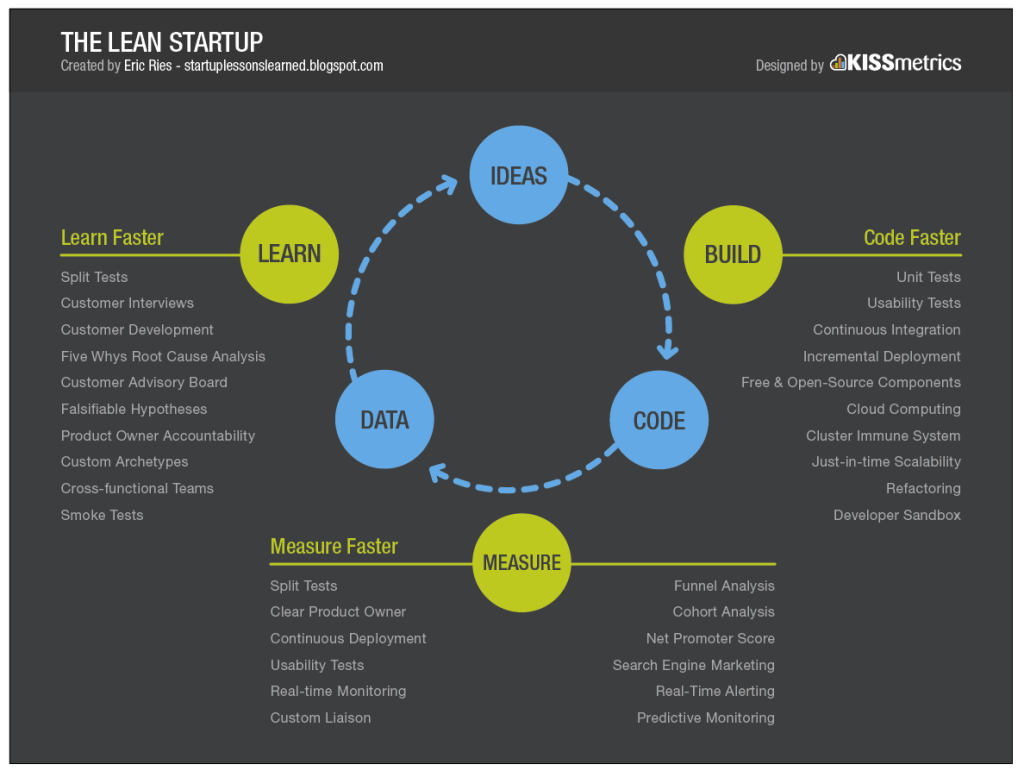
Focus on metrics that reflect value and retention, not just traffic. Track the few metrics that guide decisions and reflect user success.
- Activation rate and time-to-value
- Retention and repeat usage
- Conversion rate from visitor to signup to paid
- Churn reasons and onboarding drop-off points
- Qualitative feedback from your best users
Step 24: Run Focused Growth Experiments
Experimentation is how you find what works. Change one thing at a time, measure the result, and keep what improves your key metric. If you change everything at once, your data becomes unclear.
If you want a growth experimentation overview, see: How to Growth Hack Your Startup.
Step 25: Expanding Channels Carefully
Once you have a repeatable motion, expand carefully. Add new channels slowly. Improve onboarding before scaling acquisition. Build systems only after you have a process worth systematizing.
Scaling mistake: Scaling a leaky funnel or a weak onboarding experience makes failure faster, not success faster.
Conclusion
The most important thing you can do for your startup is validate a real need in the market, then build and grow in the right order. Start with the customer’s pain, prove demand, define the business, build the MVP that tests the hypothesis, legalize when it reduces risk, and then focus relentlessly on distribution, onboarding, and retention.
If you want a guided system with templates, structured lessons, and a step-by-step framework that helps you avoid the most common failure patterns, explore our Incubator Program. It includes a full idea validation system designed to help you build a strong foundation and move forward with confidence.
What are the biggest challenges you are facing while starting your startup? Let us know, and we will do our best to help.