

Startup metrics and key performance indicators (KPIs) help founders measure progress, diagnose problems, and make better decisions using data instead of guesswork. But not all metrics are KPIs, and not every KPI is useful at every stage of a startup.
Startup metrics are the measurable signals that show what is happening in your business. KPIs, or key performance indicators, are the specific metrics you prioritize because they tell you whether you are making progress toward an important business goal.
In our Incubator and Accelerator programs, we teach founders how to select, define, and operationalize KPIs so metrics support execution instead of creating noise. One issue shows up repeatedly: founders often track too many numbers, track the wrong numbers for their stage, or confuse activity with progress.
This guide is designed to help you choose the right KPI stack for your startup stage, business model, and growth goals. You will learn what startup KPIs are, how to choose a North Star Metric, what to track by stage, how to define metrics clearly, and how to turn KPI insights into experiments and execution.
Key idea: KPIs should guide action, not create reporting clutter. The goal is not to measure everything. The goal is to measure what matters most right now.
Startup Metrics vs KPIs: What Is the Difference?
A startup metric is any measurable signal that helps you understand what is happening in your business. Examples include website traffic, signups, email click-through rate, churn, revenue, customer acquisition cost, daily active users, or burn rate.
A KPI is a metric you elevate because it directly reflects progress toward an important business objective. For example, website traffic is a metric. But if your current goal is to increase qualified trial signups from organic search, then organic visitor-to-trial conversion rate may become a KPI.
All KPIs are metrics, but not all metrics are KPIs.
How to Choose the Right Startup KPIs
The right KPIs depend on your stage, business model, and immediate bottleneck. A pre-product founder should not track the same KPIs as a scaling SaaS company. A marketplace should not use the exact same KPI stack as a services business. Context matters.
One of the biggest KPI mistakes startups make: tracking metrics that belong to a later-stage company. Early-stage startups should prioritize learning, activation, and retention signals before optimizing mature scale metrics like CAC efficiency, revenue expansion, or net revenue retention.
The KPI Map: North Star, Inputs, and Diagnostics
A strong KPI system usually has three layers:
- North Star Metric: The primary measure of value your startup delivers.
- Input KPIs: The few key metrics that directly influence your North Star.
- Diagnostic metrics: Supporting data that helps explain why your KPIs are moving.
Example:
- North Star: Weekly activated teams
- Input KPIs: Activation rate, D7 retention, signup-to-activation rate, CAC payback
- Diagnostics: Time-to-value, onboarding completion rate, channel mix, cohort behavior
This turns KPI tracking into a decision system instead of a dashboard full of disconnected numbers.
The 60-Second Startup KPI Stack
If you only track a small handful of KPIs early on, start with metrics that show whether users are finding value, coming back, and helping you build a repeatable growth engine.
| KPI | What It Tells You | Best For |
|---|---|---|
| Activation Rate | Whether users reach a meaningful first value moment | MVPs, SaaS, product-led startups |
| Retention | Whether users keep getting value over time | SaaS, apps, marketplaces, communities |
| Revenue Growth | Whether customer demand is translating into money | Revenue-stage startups |
| CAC | How much it costs to acquire a customer | Startups testing repeatable acquisition |
| Burn Rate and Runway | How long the company can operate before needing more capital | All startups |
Rule of thumb: Most startups should focus on one North Star Metric and roughly 3–5 supporting KPIs at a time. Tracking too many metrics can dilute focus and create analysis paralysis.
Choosing Startup KPIs by Stage
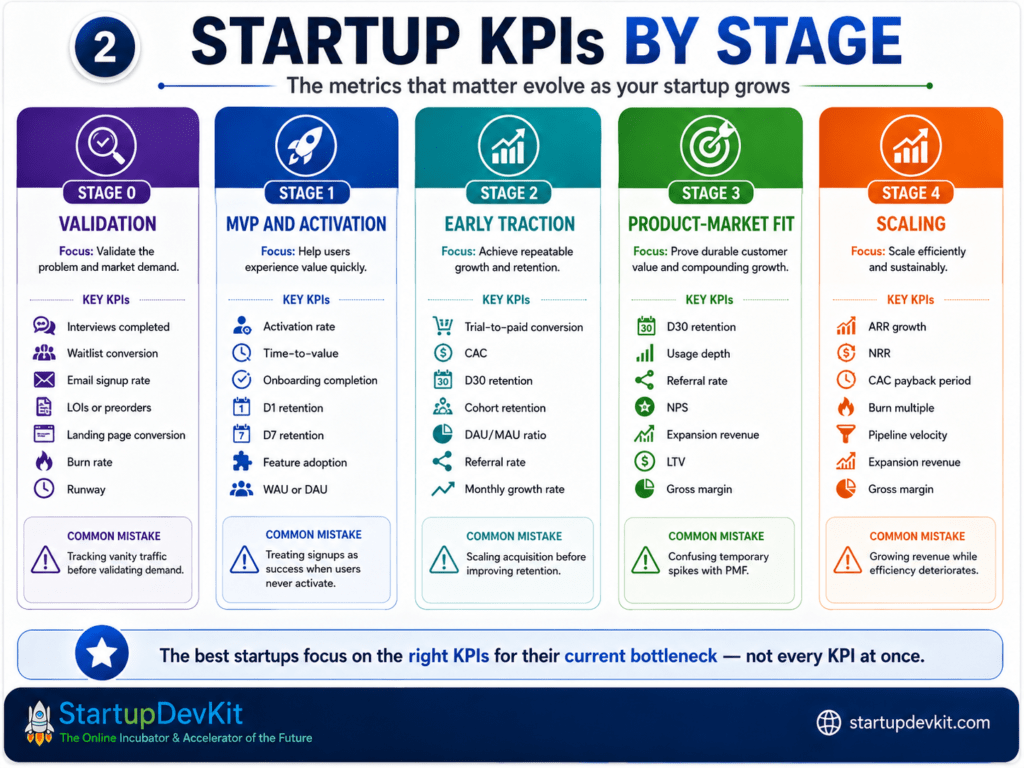
The most important startup KPIs change as your company evolves. A pre-product startup should not measure success the same way as a scaling SaaS company.
However, some metrics remain important across nearly every stage of growth. Metrics such as runway, burn rate, retention, and customer acquisition efficiency influence whether your startup has enough time and momentum to survive long enough to reach product-market fit and scale.
Important: The goal is not to track dozens of KPIs at once. The goal is to choose the few KPIs that best represent the bottlenecks, priorities, and risks of your current stage.
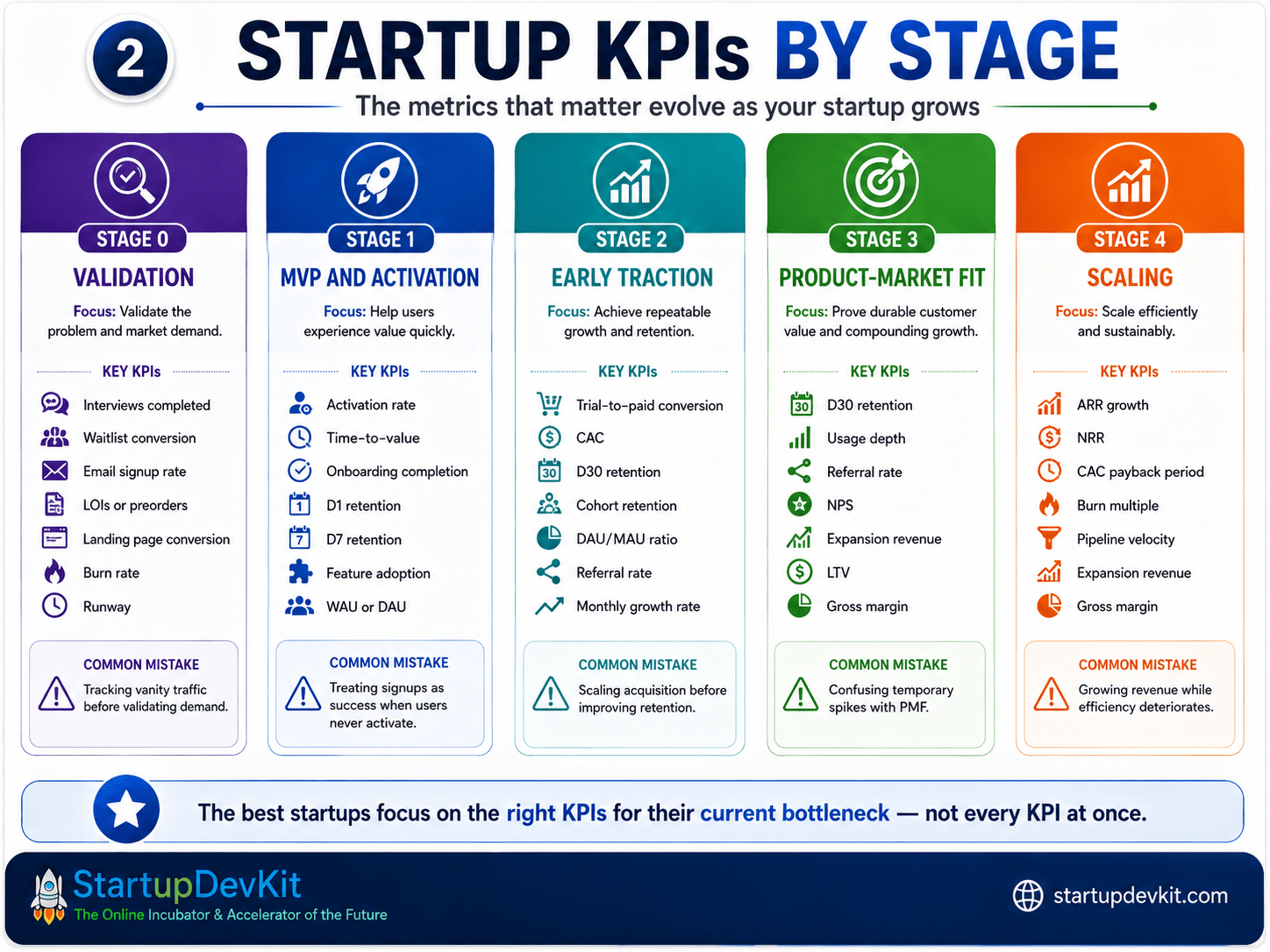
The most useful startup KPIs change as a company moves from validation to MVP, traction, product-market fit, and scaling.
Stage 0: Pre-Product and Validation
At the validation stage, your goal is not scale. Your goal is learning. You are trying to determine whether the problem is real, whether people care enough to seek a solution, and whether your proposed solution resonates strongly enough to justify building further.
Recommended KPIs and Metrics:
- Customer interviews completed
- Problem validation signals
- Waitlist conversion rate
- Landing page conversion rate
- Email signup rate
- Preorders or letters of intent (LOIs)
- Runway
- Burn rate
Why these matter: At this stage, qualitative insight is often more important than large traffic numbers. Strong validation signals reduce the risk of building something the market does not want.
Key question: Are people demonstrating real interest and urgency around the problem?
Key resource: How to Validate a Startup Idea
Stage 1: MVP and Early User Activation
Once your MVP is live, your focus shifts toward helping users experience value as quickly as possible. This is where activation and onboarding become critically important.
Recommended KPIs and Metrics:
- Activation rate
- Signup-to-activation conversion rate
- Time-to-value
- Onboarding completion rate
- D1 and D7 retention
- Feature adoption
- DAU and WAU
- Runway
- Burn rate
Why these matter: Many startups fail because users never experience the core value of the product quickly enough. Improving onboarding and activation can dramatically improve retention later.
Common mistake: Treating signups as success even when users never meaningfully engage with the product.
Key question: Are users experiencing real value quickly enough to come back?
Key resource: How to Build an MVP That People Love
Stage 2: Early Traction and First 100 to 500 Customers
At this stage, your startup begins moving beyond pure validation and into repeatable customer acquisition and retention. You are trying to prove that growth can happen consistently and sustainably.
Recommended KPIs and Metrics:
- Weekly and monthly growth rate
- Visitor-to-signup conversion rate
- Trial-to-paid conversion rate
- CAC (Customer Acquisition Cost)
- D30 retention
- Retention by cohort
- Monthly churn rate
- DAU/MAU ratio
- Referral rate
- Runway
- Burn rate
Why these matter: You are beginning to test whether your startup has the foundations for scalable growth. Retention and activation become increasingly important because weak retention creates expensive churn.
Relationship insight: High acquisition with poor activation or retention usually leads to unsustainable growth economics.
Key question: Are users staying, returning, and converting consistently enough to justify scaling?
Key resource: How to Get Your Startup’s First 100 and 500 Customers
Stage 3: Product-Market Fit Pursuit
At the product-market fit stage, the goal is to determine whether your startup is creating durable value for a growing base of users or customers.
Recommended KPIs and Metrics:
- Cohort retention curve flattening
- D30 and longer-term retention
- Expansion revenue
- NPS (Net Promoter Score)
- Referral rate and virality
- Usage depth
- LTV (Lifetime Value)
- CAC
- Gross margin
- Runway
- Burn multiple
Why these matter: Product-market fit is often reflected through retention, repeat usage, referrals, and strong customer pull rather than just top-line acquisition.
Common mistake: Confusing temporary acquisition spikes with true product-market fit.
Key question: Are customers consistently receiving enough value that growth can compound naturally?
Key resource: Guide to Product-Market Fit
Stage 4: Scaling and Operational Efficiency
Once your startup begins scaling, the focus shifts toward efficiency, expansion, operational durability, and sustainable economics.
Recommended KPIs and Metrics:
- MRR and ARR growth
- NRR (Net Revenue Retention)
- CAC payback period
- Pipeline velocity
- Gross margin
- Burn multiple
- Expansion revenue
- Customer concentration risk
- Runway
- Net churn
Why these matter: Scaling startups must prove not only growth, but also operational efficiency and long-term sustainability.
Relationship insight: Efficient retention and expansion revenue often create stronger long-term economics than relying entirely on new customer acquisition.
Key question: Can the business scale efficiently while maintaining strong retention and healthy margins?
Startup KPI and Metrics Reference List
There are many startup metrics and KPIs you can use to measure performance. The goal is not to track all of them. The goal is to choose the right KPI stack for your startup’s stage, business model, and bottleneck.
Some metrics are leading indicators, meaning they help predict future performance. Others are lagging indicators, meaning they reflect outcomes that have already occurred.
- Leading indicators: Activation rate, onboarding completion, product usage frequency, qualified pipeline growth
- Lagging indicators: Revenue, churn, profit margin, annual recurring revenue
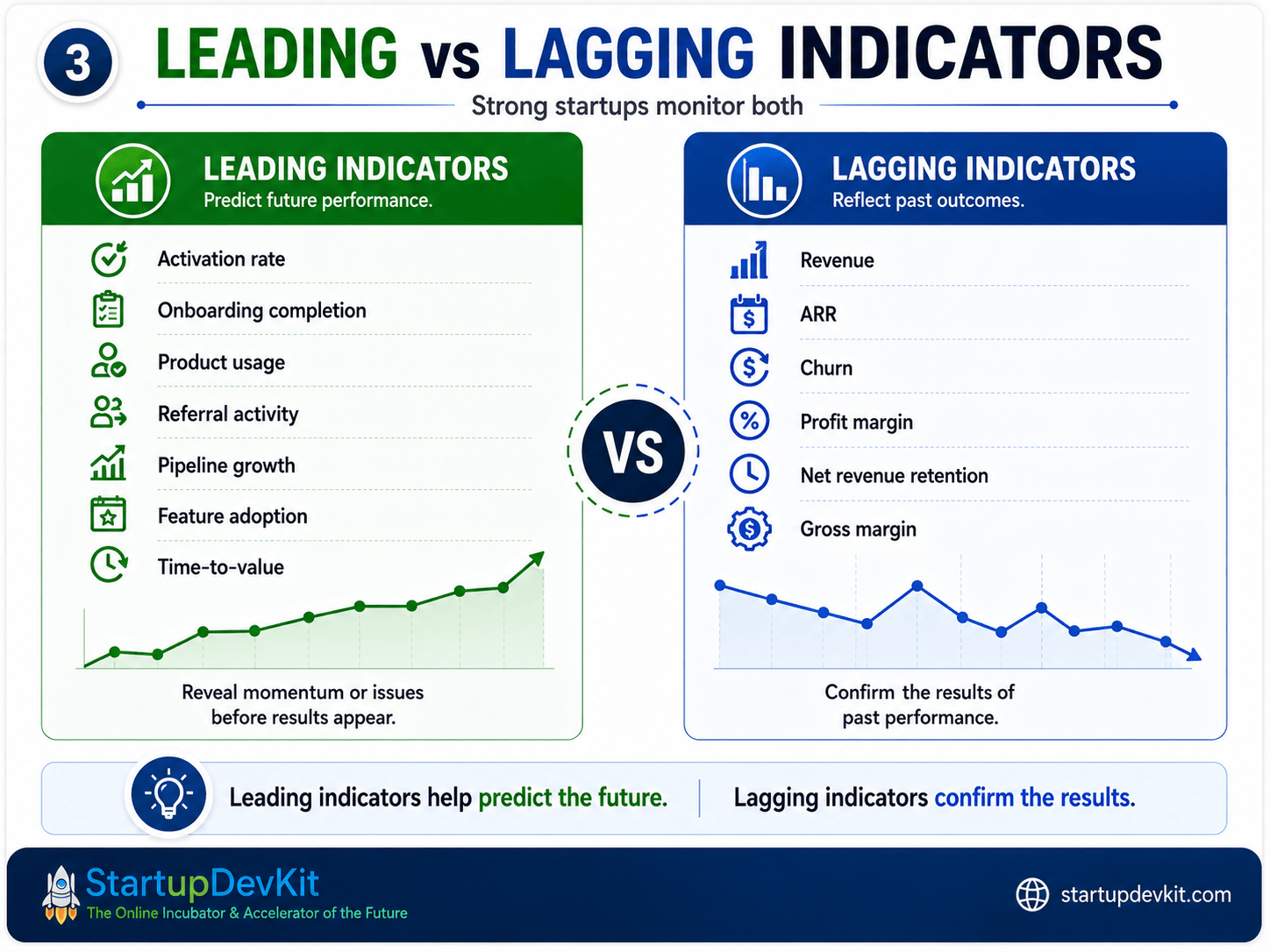
Leading indicators help startups predict future performance, while lagging indicators confirm the results of past decisions.
Important: Large traffic numbers, social followers, downloads, or impressions can create the illusion of traction without improving retention, activation, revenue, or customer value. Avoid obsessing over vanity metrics.
Use the sections below as a reference library and prioritize the metrics most relevant to your startup’s current goals.
Vanity Metrics vs Actionable Metrics
Not every metric represents meaningful progress. Some metrics look impressive on the surface but do not necessarily show whether your startup is creating customer value, improving retention, increasing revenue, or becoming more sustainable.
These are often called vanity metrics. Examples include raw traffic spikes, social followers, impressions, downloads without retention, unqualified signups, or app installs without activation.
Actionable metrics, by contrast, help you make better decisions. They show whether users are reaching value, coming back, converting, paying, referring others, or helping the business become more efficient.
Key idea: A metric only matters if it helps you decide what to improve, test, stop, or double down on.
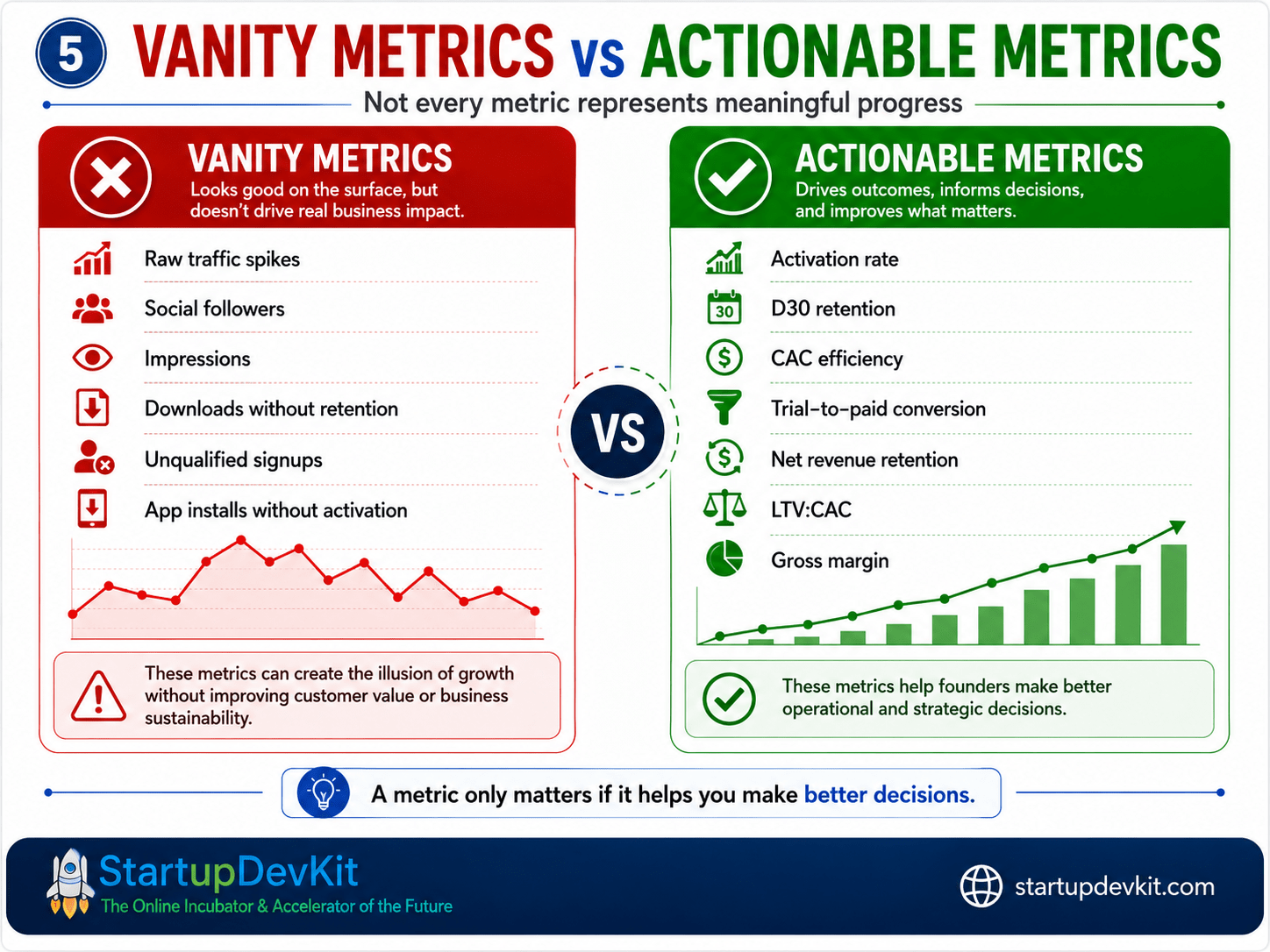
Vanity metrics may look impressive, but actionable metrics help founders make better strategic and operational decisions.
Revenue and Monetization KPIs
MRR (Monthly Recurring Revenue) = The amount of recurring revenue your startup generates monthly.
Why it matters: MRR helps subscription businesses measure growth consistency and forecast future revenue.
ARR (Annual Recurring Revenue) = The amount of recurring revenue your startup generates annually.
Why it matters: ARR is commonly used by SaaS startups and investors to evaluate long-term growth trajectory.
Annual Run Rate = A projection of current revenue into the future, annualized.
Common mistake: Annual Run Rate is not the same as Annual Recurring Revenue. ARR is contracted recurring revenue; Run Rate is a projection.
ARPA (Average Revenue per Account) = Average revenue generated per account.
Why it matters: ARPA helps startups understand customer monetization efficiency and pricing leverage.
ARPU (Average Revenue per User) = Average revenue generated per user.
Gross Profit = Total revenue minus the cost of goods sold.
Gross Margin = Revenue minus cost of goods sold, expressed as a percentage of revenue.
Why it matters: Strong gross margins increase flexibility for hiring, marketing, and scaling operations.
LTV (Lifetime Value) = Prediction of the net value generated from the future relationship with a customer.
Relationship insight: Increasing retention often improves LTV more efficiently than simply lowering CAC.
Expansion Revenue = Additional revenue generated from existing customers through upsells, cross-sells, upgrades, or usage growth.
Deferred Revenue = Revenue received in advance before it is earned.
Billings = Revenue plus changes in deferred revenue during a period.
Acquisition and Funnel KPIs
CAC (Customer Acquisition Cost) = How much it costs, on average, to acquire a customer.
Why it matters: CAC helps startups understand whether their growth engine is economically sustainable as they scale acquisition.
Common mistake: Founders often calculate CAC without including labor, software, creative production, or agency costs.
Visitor-to-Lead Conversion Rate = Percentage of website visitors who become leads.
Visitor-to-Signup Conversion Rate = Percentage of visitors who create an account or sign up.
Signup-to-Activation Rate = Percentage of signups who reach a defined activation event.
Relationship insight: High acquisition with weak activation usually creates expensive churn instead of durable growth.
Trial-to-Paid Conversion Rate = Percentage of trial users who become paying customers.
Lead-to-Customer Conversion Rate = Percentage of leads who become customers.
Pipeline Velocity = The speed at which opportunities move through your sales pipeline.
Close Rate = Percentage of qualified opportunities that become customers.
Product Usage and Engagement KPIs
DAU (Daily Active Users) = The number of users who return to your startup’s app or website daily.
WAU (Weekly Active Users) = The number of users who return weekly.
MAU (Monthly Active Users) = The number of users who return monthly.
DAU/MAU Ratio = A stickiness metric comparing daily active users to monthly active users.
Why it matters: DAU/MAU helps startups understand how habit-forming and engagement-driven their product is.
Activation Rate = Percentage of users who complete a key action that indicates they experienced initial value.
Common mistake: Many startups define activation too loosely. A signup is not activation if the user never experiences value.
Time-to-Value = How long it takes a user to experience meaningful value after signup or onboarding.
Why it matters: Faster time-to-value usually improves activation, retention, and trial-to-paid conversion rates.
Feature Adoption = Percentage of users who adopt a specific feature.
Onboarding Completion Rate = Percentage of users who complete onboarding.
Usage Depth = The extent to which users engage with multiple parts of your product.
Number of Logins = The number of times users log into your platform.
Growth, Retention, and Churn KPIs
MoM (Month-over-Month Growth) = The rate of growth from one month to the next.
CMGR (Compounded Monthly Growth Rate) = The average monthly growth rate over a period of time accounting for compounding.
D1 Retention = Percentage of users who return one day after first use.
D7 Retention = Percentage of users who return seven days after first use.
D30 Retention = Percentage of users who return thirty days after first use.
Why these matter: Retention metrics are some of the strongest indicators of product-market fit and long-term customer value.
Retention by Cohort = Percentage of a user cohort that remains active over time.
MCR (Monthly Churn Rate) = Lost customers this month divided by customers at the start of the month.
GCR (Gross Churn Rate) = MRR lost in a given month divided by MRR at the beginning of the month.
Net Churn = MRR lost minus expansion revenue divided by MRR at the beginning of the month.
NRR (Net Revenue Retention) = Revenue retained from existing customers including expansion and contraction.
Why it matters: NRR is one of the most important SaaS metrics because it measures how effectively existing customers grow or shrink over time.
GRR (Gross Revenue Retention) = Revenue retained from existing customers excluding expansion revenue.
Referral Rate = Percentage of users or customers who refer others.
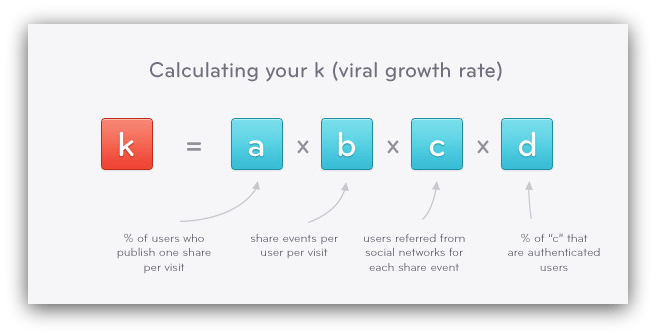
Virality = Viral coefficient calculated from invitations sent multiplied by invitation conversion rate.
Important context: Viral growth metrics are most relevant for referral-driven, social, marketplace, or network-effect products.
NPS (Net Promoter Score) = A customer satisfaction and referral likelihood metric.
Common mistake: NPS without retention or behavioral analysis can create misleading conclusions.
Cash, Efficiency, and Runway KPIs
Monthly Cash Burn Rate = How much money your startup spends per month.
Gross Burn = Total monthly expenses plus other cash outlays.
Net Burn Rate = Gross burn minus revenue.
Runway = How long your startup can continue operating before running out of cash.
Why it matters: Runway determines how much time your startup has to achieve traction, profitability, or additional fundraising.
CAC Payback Period = The amount of time required to recover CAC through gross profit.
Burn Multiple = Net burn divided by net new ARR.
Why it matters: Burn multiple has become a widely used efficiency metric among SaaS operators and investors.
Market and Strategic KPIs
TAM (Total Addressable Market) = The total revenue opportunity available for a product or service.
SAM (Serviceable Available Market) = The portion of the market your startup can realistically serve.
SOM (Serviceable Obtainable Market) = The realistic market share your startup may be able to capture.
CCR (Customer Concentration Risk) = Revenue from your largest customer divided by total revenue.
Why it matters: Heavy dependence on one customer creates financial risk if that customer leaves.
Platform Risk = Dependence on a specific platform, ecosystem, or acquisition channel.
Organic Traffic = Unpaid traffic from search engines.
Direct Traffic = Traffic arriving directly through URLs, bookmarks, or untracked links.
Network Effects = The effect where one user increases the value of the product for other users.
Why it matters: Strong network effects can dramatically improve defensibility, retention, and organic growth.
KPI Goals and North Star Metrics
Before you can measure any marketing campaign, startup website, or product performance, you need numerical goals measured with KPIs.
When you create goals for your startup, identify your top one or two KPIs. Ideally, choose one primary North Star Metric supported by a small set of input KPIs.
Finding Your North Star Metric
You can find your North Star Metric by asking: what is the primary value our product delivers, and how can we measure whether that value is increasing?
Some companies focus on free trial signups and paid conversions because those events show commercial movement. Some startups acquire users easily but must focus primarily on retention. Facebook’s North Star has historically been daily active users because user engagement drives ad inventory and revenue.
Which KPI you use depends on the goals of your product, service, website, or platform.
KPI Goal Setting
If a startup sets loose goals, it will usually get loose results. Set specific goals for your key metrics and connect them to real execution activities.
You do not need a perfect analytics stack to begin using KPIs effectively. Early-stage founders benefit most from choosing a small number of meaningful metrics and improving decision-making consistency over time.
Reverse Engineering Startup KPI Goals
Once you choose your North Star Metric and supporting KPIs, the next step is to reverse engineer the outcomes you want. This helps you move from vague ambition to measurable execution.
Instead of saying, “We want more users,” define the exact outcome, the timeframe, and the activities that could realistically drive it.
Simple framework: Desired outcome → required KPI movement → weekly target → daily or weekly activities → experiments → review cadence.
Example: If your goal is to gain 500 activated users in 90 days, you would work backward from that number:
- Goal: 500 activated users in 90 days
- Monthly target: About 167 activated users per month
- Weekly target: About 39 activated users per week
- Daily target: About 6 activated users per day
- Input activities: Outreach, content, referrals, onboarding improvements, and conversion experiments
This does not mean every day will perform perfectly. The point is to create a target you can manage, measure, and adjust instead of relying on hope.
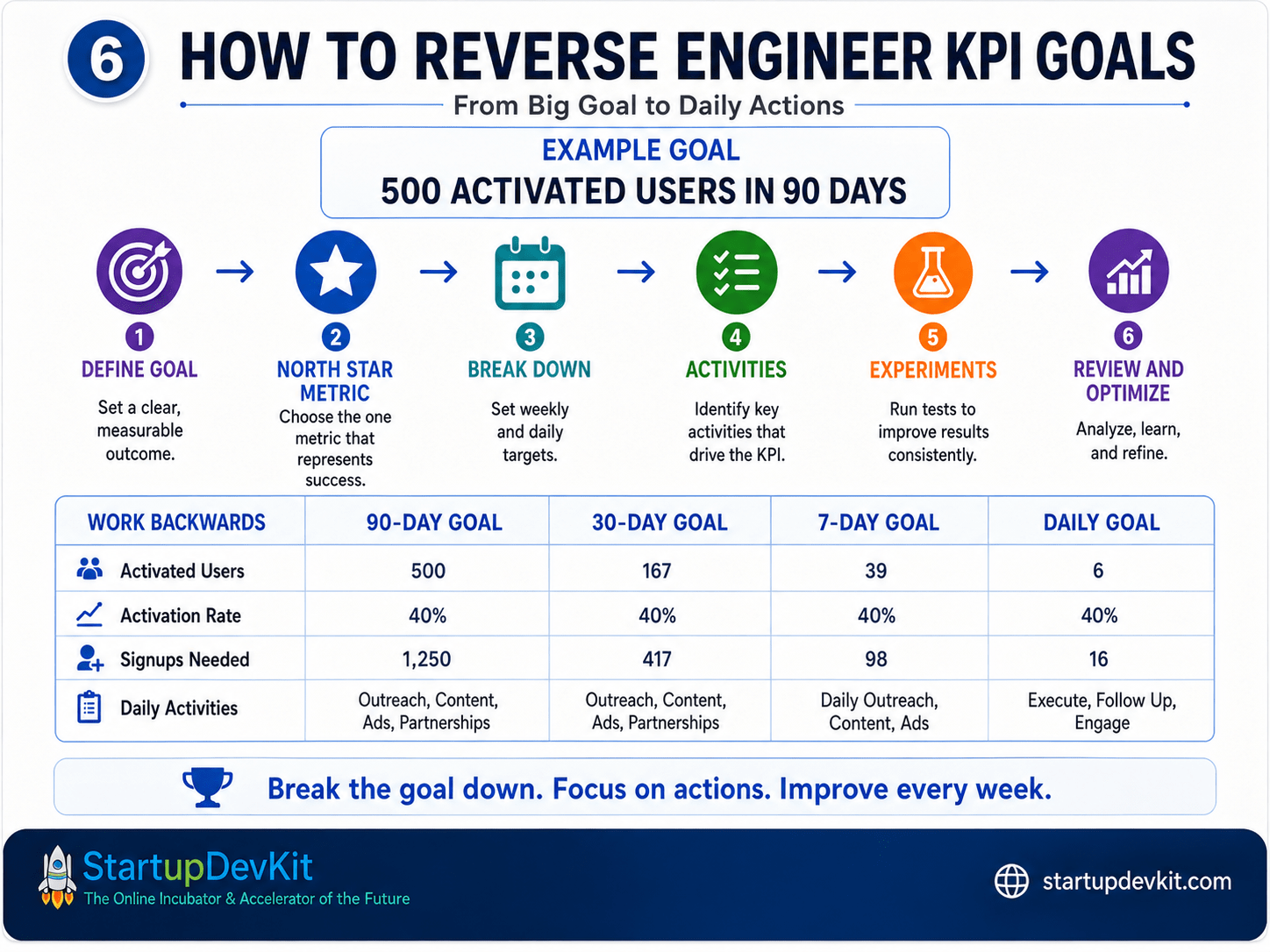
Reverse engineering KPI goals helps founders turn big targets into measurable actions, experiments, and review cycles.
Aligning Activities Toward Your KPI Goals
After you define the target, identify which activities can realistically move the KPI. This is where many founders go wrong. They choose a KPI, but their weekly work does not directly influence it.
For example, if your KPI is activation rate, posting more on social media may help acquisition, but it probably will not fix activation. Activation usually improves through onboarding, product education, clearer first steps, better templates, faster time-to-value, and user guidance.
| KPI Goal | Activities That Can Move It | Activities That May Distract |
|---|---|---|
| Increase activation rate | Improve onboarding, shorten setup, add checklists, clarify first value moment | Posting more content without fixing the product experience |
| Increase qualified leads | Improve landing pages, publish targeted content, add lead magnets, run outbound campaigns | Driving broad traffic that does not match your target customer |
| Improve retention | Analyze cohorts, interview retained users, improve product value, send lifecycle emails | Adding new features without understanding why users leave |
| Increase trial-to-paid conversion | Improve onboarding, clarify pricing, add nurture emails, surface success moments earlier | Getting more trial users before fixing why trials do not convert |
The goal is to create a direct line between what you measure and what your team actually does.
Example Startup KPI Goal Scenarios
Here are a few practical examples of how different startups might reverse engineer KPI goals.
Example 1: Product-Led SaaS Activation
- Goal: Increase activation rate from 22 percent to 35 percent in 60 days
- KPI: Activation rate
- Hypothesis: Users are not reaching value because onboarding is too long and unclear
- Experiments: Shorten onboarding, add a progress checklist, improve welcome email, add an in-app first action prompt
- Review cadence: Weekly cohort review
Check your results after you get a sizeable chunk of conversion opportunities, such as at either 50 or 100 opportunities. Do not change anything while your experiment is active or you’ll poison your results.
Example 2: Content-Led Acquisition
- Goal: Generate 300 qualified leads from organic search in 90 days
- KPI: Organic visitor-to-lead conversion rate
- Hypothesis: Existing blog traffic is not converting because lead magnets are not aligned to search intent
- Experiments: Add intent-matched lead magnets, improve CTAs, add internal links from high-traffic posts, refresh outdated posts
- Review cadence: Weekly Search Console and conversion review
Example 3: Retention Improvement
- Goal: Improve D30 retention by 15 percent over the next quarter
- KPI: D30 retention
- Hypothesis: Users who do not complete the second key action are less likely to return
- Experiments: Add lifecycle emails, improve user education, prompt the second key action sooner, interview retained users
- Review cadence: Monthly cohort review
SMART KPIs
According to Pyramid Analytics, SMART stands for specific, measurable, actionable, relevant, and timely. They gave us permission to share their expertise on KPI effectiveness and SMART KPIs through the image below.
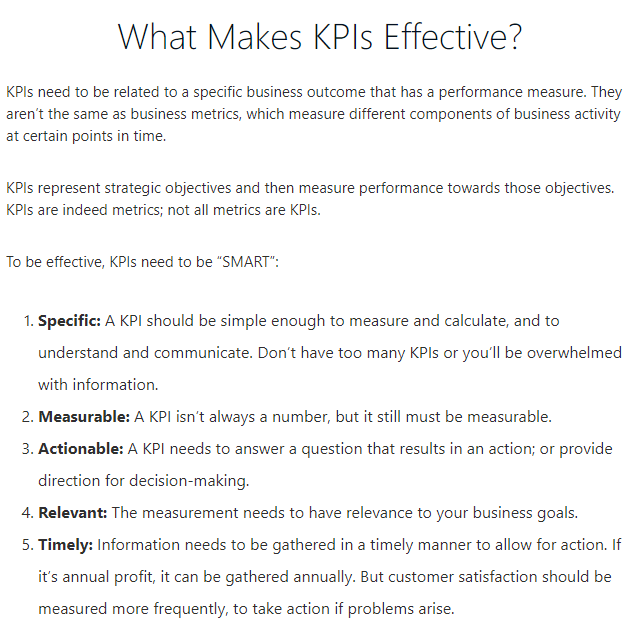
Your startup’s North Star Metric and supporting KPIs should be SMART. But for startups, I would add one more requirement: your KPIs should be decision-useful.
A KPI is not useful just because it is measurable. It is useful when it helps you decide what to do next.
- Specific: The KPI has a clear definition.
- Measurable: You can track it consistently.
- Actionable: Your team can influence it through specific activities.
- Relevant: It matches your current stage and business goals.
- Timely: You review it often enough to make decisions.
- Decision-useful: It helps you choose what to do next.
Keeping Track of Performance and Measuring Progress
Having a handful of your top KPIs tracked in a spreadsheet or dashboard can help you maintain laser-focused attention on what matters most. But the tool matters less than the habit.
You can start simple:
- Choose one North Star Metric
- Choose 3 to 5 supporting KPIs
- Define each KPI clearly
- Assign an owner
- Review progress weekly or monthly
- Choose one or two experiments based on what the numbers show
Below is an example of a SaaS spreadsheet metrics dashboard created in Google Sheets by Growth Everywhere.

Practical rule: If a KPI review does not lead to a decision, an experiment, or a change in priorities, you are probably reporting more than you are managing.
AARRR Pirate Metrics: The Five KPIs in the Startup Funnel
Based on the acronym AARRR, there are five major startup funnel stages according to Dave McClure, a founder of 500 Startups.
The stages are acquisition, activation, retention, referral, and revenue.
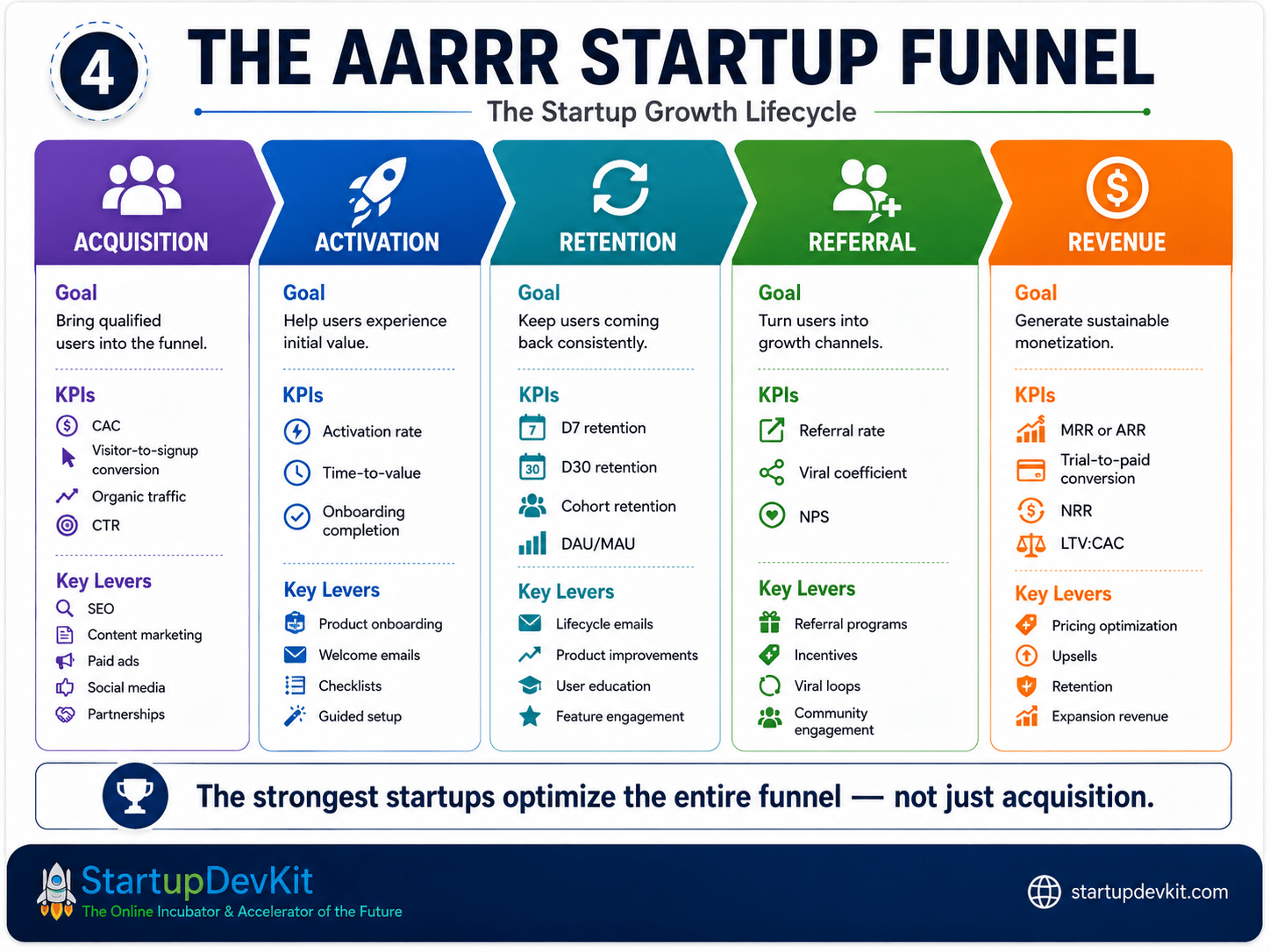
1) Acquisition
Definition: Acquisition measures the number of users or customers gained through marketing channels.
Core KPIs: Website visitors, channel conversion rate, visitor-to-signup rate, CAC, qualified leads.
Levers you can pull: SEO, partnerships, social media, SEO, paid advertising, community participation, content marketing, and outbound.
Key resource: How to Get Your Startup’s First 100 and 500 Customers
2) Activation
Definition: Activation measures how well users reach meaningful first value after the initial interaction.
Core KPIs: Activation rate, time-to-value, onboarding completion rate, first key action completed.
Levers you can pull: Better onboarding, product tours, triggered emails, checklists, templates, default settings, and clearer first-use guidance.
3) Retention
Definition: Retention measures your ability to keep users engaged over time.
Core KPIs: D7 retention, D30 retention, cohort retention, churn rate, repeat usage.
Levers you can pull: Product improvements, lifecycle email, user education, support, customer success, onboarding improvements, and reactivation campaigns.
Retention expectations vary by business model. A daily-use consumer app, a monthly B2B workflow product, and a low-frequency marketplace will not have the same retention profile. Compare cohorts, improve trendlines, and understand why users stay or leave.
4) Referral
Definition: Referral measures the number of users acquired through word of mouth, sharing, recommendations, or referral systems.
Core KPIs: Referral rate, viral coefficient, share rate, NPS, referred customer conversion rate.
Levers you can pull: Referral programs, incentives, product sharing loops, social proof, customer delight, and viral marketing tools.
Referrals are integral to product-led marketing and can help create network effects and virality. Encouraging satisfied users to refer others is a cost-effective way to acquire new customers.
- Referral Raffle Contest: You can hold referral raffle contests for participants to win something valuable, such as a subscription, physical product, or premium service.
- Free Credits or Subscriptions for Referrals: You can create a referral program where referrers get bonus perks, money, or credits toward your products. You can use viral marketing tools, available referral tools, or a custom system like Dropbox’s.

If you gain strong traction with referrals, you can calculate your viral growth rate as shown below.
5) Revenue
Definition: Revenue measures the income generated from paying customers.
Core KPIs: MRR, ARR, ARPA, trial-to-paid conversion, LTV, CAC payback, expansion revenue.
Levers you can pull: Pricing experiments, packaging, upsells, cross-sells, sales process improvements, retention improvements, and better activation.
To learn more about startup sales, read The Ultimate Startup Sales Playbook for Founders.
AARRR Conclusion
By monitoring and optimizing these startup metrics, startups can develop a deeper understanding of the customer journey and improve business performance. The sequence of these metrics may vary depending on the business model, but together they provide a comprehensive view of growth and sustainability.
Defining KPIs So You Do Not Lie to Yourself
Every KPI should have a clear definition, formula, data source, owner, review cadence, and response plan. If two people on your team define activation differently, your KPI will create confusion instead of clarity.
KPI Definition Sheet
| KPI Name | Exact Definition | Formula | Data Source | Frequency | Owner | Target | If This Drops, Check |
|---|---|---|---|---|---|---|---|
| Activation Rate | Percent of new users who reach first value | Activated users / new users | Product analytics | Weekly | Product | Improve from baseline | Onboarding, channel mix, time-to-value |
| D7 Retention | Percent of users who return seven days after first use | Users active on day 7 / new users | Product analytics | Weekly | Product | Improve by cohort | Activation quality, product value, user segment |
KPI Experiment Backlog
| KPI | Hypothesis | Experiment | Expected Lift | Effort | Result |
|---|---|---|---|---|---|
| Activation Rate | If we shorten onboarding, more users will reach first value. | Reduce onboarding steps and add checklist. | 10 to 20 percent | Medium | Pending |
| Trial-to-Paid Conversion | If users experience success earlier, more trials will convert. | Add guided setup and first-success email sequence. | 5 to 15 percent | Medium | Pending |
Avoiding Paralysis by Analysis
Bob Parsons, the founder of GoDaddy, once said, “Anything that is measured and watched, improves.” Measurement matters, but too much measurement can create paralysis by analysis.
To avoid wasting time, schedule specific times to monitor your KPIs and make decisions. Do not stare at dashboards all day. Review your numbers, identify the bottleneck, choose an experiment, and move forward.
I like Fridays because it is often the least active business day, making it a useful time to review performance, plan changes, and optimize StartupDevKit for the following week.
Frequently Asked Questions — Startup KPIs and Metrics
- What are startup KPIs?
- Startup KPIs are the few critical measures that show whether your company is progressing toward its goals. They turn strategy into trackable outcomes across acquisition, activation, retention, revenue, and referrals.
- What is the difference between a KPI and a metric?
- Startup metrics are measurable signals that show what is happening in your business. KPIs are the specific metrics you prioritize because they show whether you are making progress toward an important business goal.
- What is a North Star Metric for a startup?
- A North Star Metric captures the core value your product delivers to customers, aligning teams around one growth outcome. Examples include weekly active teams, qualified bookings, activated accounts, or successful orders delivered.
- How should early-stage vs. mid-stage startups choose KPIs?
- Early-stage teams prioritize leading indicators such as activation rate, D1 or D7 retention, waitlist conversion, and user feedback. Mid-stage teams add revenue efficiency and scale metrics like CAC, LTV, payback period, pipeline velocity, and net revenue retention.
- What are AARRR funnel metrics?
- AARRR stands for acquisition, activation, retention, referral, and revenue. These metrics help startups understand how users move through the funnel from first touch to monetization and referral.
- How many KPIs should a startup track?
- Focus on 3 to 5 company-level KPIs plus a small set per team. Too many KPIs dilute attention. A concise KPI stack clarifies tradeoffs and speeds decisions.
- How do we set realistic KPI targets or benchmarks?
- Start with your current baseline, analyze cohorts, compare to stage-appropriate benchmarks, and set rolling monthly or quarterly targets tied to experiments you can actually run.
- What tools should we use to track startup KPIs?
- Use product analytics for activation and retention, web analytics for acquisition, a CRM for pipeline and revenue, and a spreadsheet or BI dashboard to unify your KPI view with UTMs and cohort definitions.
Conclusion
Key performance indicators are not about tracking everything. They are about focusing your attention on the metrics that matter most for your startup’s current stage.
The best founders do not drown themselves in dashboards. They identify the few metrics that matter, define them clearly, connect them to experiments, and iterate relentlessly.
If you are new to using analytics and KPIs, do not get overwhelmed. Start small, choose a North Star, build a supporting KPI stack, and improve your measurement system as your startup grows.