

If you’re like many startup founders, you’ve considered raising venture capital for your startup. Knowing when to seek venture capital and how to do it are two of the most important things to understand before approaching investors for any investment. It sets expectations, prevents wasted effort, and helps you focus on the work that actually increases your odds of raising.
Many startups try to fundraise the wrong way. They pitch too early, target the wrong firms, rely on vague narratives without proof, or ask for money without a clear plan for how capital changes the trajectory of the business. In this guide, you will learn a modern, step by step approach to raising venture capital for pre seed, seed, and Series A.
Reality check: Venture capital is not a milestone, a badge, or a requirement. Fundraising amplifies what already exists. It does not fix broken fundamentals. If your product, positioning, retention, or acquisition engine is unstable, capital usually increases the speed at which problems grow.
In our Accelerator, we teach founders how to approach venture fundraising as a structured process rather than a series of ad hoc conversations. This includes how to build relationships with investors, how to leverage portfolio networks appropriately, and how to run an organized fundraising campaign without wasting time or burning credibility.
We are sharing that same process here so you can understand how venture fundraising actually works and move forward with greater confidence.
Who This Guide Is For
This guide assumes a startup is already prepared to raise venture capital and has met the typical prerequisites. If you’re unsure whether you’re ready yet, start with this fundraising readiness guide, Raising Venture Capital: What Startups Need Before Fundraising.
- Pre seed and seed-stage founders with early traction and a clear path to repeatable growth.
- Teams preparing for a Series A who need a tighter growth story, stronger metrics, and a cleaner process.
- Founders who want a realistic fundraising plan including targeting, intros, outreach, meetings, diligence, and closing.
Who This Guide Is Not For
- Idea stage startups looking for capital to “start building” without validation, early users, or a clear wedge.
- Lifestyle businesses or local services where the upside is not venture scale.
- Founders who primarily need a cash bridge instead of a growth accelerant.
You will learn:
- When it is actually the right time to seek venture capital
- How investors think and what they are truly screening for
- The real purpose of your first VC meeting
- Which venture capital firms and partners to target
- How warm intros work and how to earn them
- How to approach cold outreach without burning your reputation
- What the VC process looks like from first meeting to close
- How to prepare for meetings, diligence, and term sheets
When Is the Right Time to Seek Venture Capital Investment
There is no single perfect moment to raise venture capital, because it depends on your business model, market, team, and rate of growth. But there are clear patterns. Outside of team quality, the most important signal is traction combined with a believable path to repeatable, scalable growth.
The Venture Capital Decision Framework
Before you raise, you want clarity on one question: What does capital unlock that you cannot unlock with smart bootstrapping in a reasonable timeframe. If you cannot answer that cleanly, fundraising will likely be a distraction.
Use This Quick Decision Test
- Is the upside venture scale meaning the business can plausibly become very large within 7 to 10 years.
- Is there a real growth engine that can be scaled with capital rather than invented with capital.
- Is the capital purpose specific such as hiring for a proven motion, accelerating distribution, scaling infrastructure, or expanding into proven segments.
- Is the timeline urgent because the market is moving fast, competition is real, or the opportunity is time sensitive.
VC Readiness Checklist
- Traction: Real usage, revenue, retention, or growth indicators that reduce uncertainty.
- Clarity: A crisp narrative that ties market pain to product, wedge, and growth path.
- Repeatability: At least one acquisition or distribution path you can repeat and measure.
- Scalability: A model that gets stronger with size rather than breaking at scale.
- Team: A credible team that can execute quickly and learn fast.
- Capital plan: A 12 to 18 month plan that ties spend to measurable milestones.
Team
Team quality matters because VCs underwrite execution under uncertainty. A strong team signals speed, resilience, and the ability to adapt. Solo founders can raise, but it is rarer. If you are solo, you want to offset that with unusually strong traction, unusual domain authority, or a clear plan to recruit key roles.
Scalability
Sometimes you need capital because scaling the product or go to market requires hiring expensive talent, building infrastructure, or expanding distribution quickly. If you can sustainably grow without venture capital, it may not be right for you yet. That can change later, but the best time to raise is when capital accelerates something already working.
Example of Legitimate VC Readiness
You have grown fast with a unique physical product. Your total addressable market is large. Demand is high. But you are hitting a ceiling due to margins, production constraints, and supply chain limitations. You can increase margins and meet demand by placing higher quantity orders and optimizing costs, but you cannot finance the inventory and warehousing yourself. In this case, venture capital can unlock a scale jump that bootstrapping cannot reach fast enough.
And it is at that point that you may be ready to seek venture capital investment.
Key principle: Raising capital for the sake of raising capital is not a plan. You need to need the capital, and you need to show how capital converts into growth milestones with measurable outcomes.
How You Grow
You should be running growth experiments and seeing evidence of repeatability. The earliest stage usually requires doing things that do not scale to earn insight, earn early customers, and refine positioning. Over time, you want to identify channels or loops that are measurable and scalable. If you cannot show a path to scalable acquisition or distribution, it will be difficult to raise institutional capital.
Your Rate of Growth
VC is an accelerant. When you are growing fast month over month and you can explain why the growth is repeatable, sustainable, and scalable, investors pay attention. Growth without retention, however, is fragile. Strong fundraising stories increasingly combine growth with quality signals such as retention, expansion revenue, engagement, activation, or strong unit economics relative to the model.
Inside Investors Minds Learn What They Look For
This infographic captures how many institutional investors prioritize opportunity, execution, and leverage.
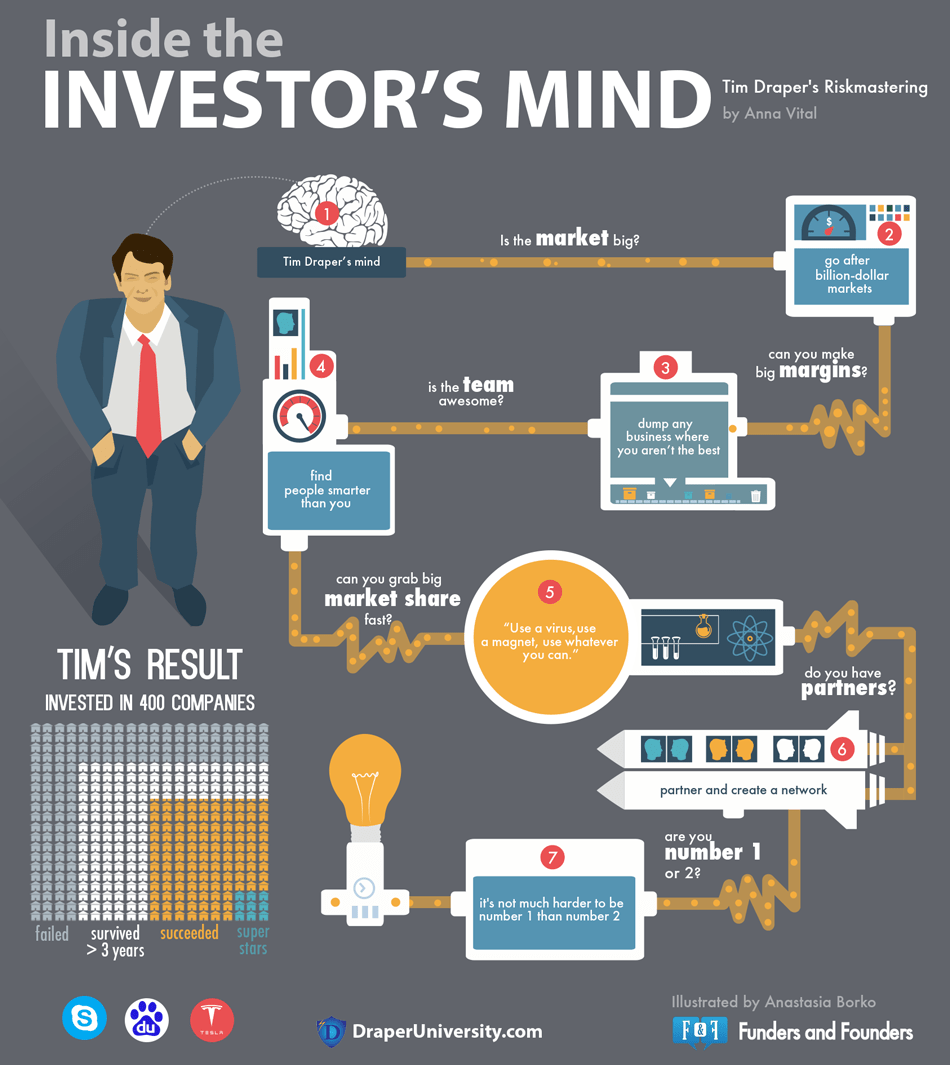
At a high level, investors are trying to reduce uncertainty. They want to believe that a very large outcome is possible and that your team can execute toward it. Tim Draper highlights a few classic lenses: market size, margins, team strength, speed, partnerships, and network effects.
In practice, most VCs quickly screen for four buckets: market, team, traction, and path to scale. If one bucket is weak, another must be unusually strong to compensate.
What Has Changed in the Current Fundraising Environment
Across many markets, the bar has risen for seed and beyond. Investors often want more proof, clearer metrics, and more disciplined capital plans. Narrative matters, but it must be backed by evidence. This is especially true for teams without a long track record or for startups in crowded categories.
What the VC Fundraising Process Actually Looks Like
Fundraising is usually a multi step process. If you expect a single meeting to turn into a check, you will get discouraged. The real game is momentum. You build interest, increase conviction, pass diligence, and close.
Typical Stages of a Round
- Preparation: tighten metrics, story, deck, and target list.
- Warm up: line up warm intros, reactivate relationships, and seed context.
- First meetings: screen for fit and spark interest.
- Second meetings: deeper questions, product demos, partner involvement.
- Partner meeting: decision maker evaluation and internal champion building.
- Diligence: customer calls, metric verification, legal and financial checks.
- Term sheet: negotiation of valuation and key terms.
- Closing: paperwork, allocations, final investor coordination.
Typical Timelines
- Pre seed: often 4 to 10 weeks depending on intros and traction.
- Seed: often 6 to 12 weeks with more diligence and partner involvement.
- Series A: often 8 to 16 weeks and can be longer in tougher markets.
The Purpose of an Initial Meeting with a VC
The purpose of your initial meeting with a VC is not to secure funding immediately, no matter how urgent your situation feels. The purpose is to earn the next meeting and increase investor conviction step by step.
You do not go on a first date and expect to marry that person. Instead, your goal is to build interest and comfort so you can get to the next date. Fundraising is similar. Your goal is momentum.
In your first meeting with one or more VCs from the firm, you will typically present a pitch deck. You may also provide your executive summary in the first meeting or afterward, depending on the firm and how they operate. Many firms ask you to include a pitch deck or executive summary when you reach out.
Venture capitalists want to do due diligence on you, your team, and your startup. If they do not ask for more information or a follow up, it often means they are not interested or do not see a clear next step. Either way, understanding the purpose of the first meeting helps you focus on what matters: clarity, credibility, and a believable path to scale.
What VCs Are Testing for in the First Meeting
- Clarity of thinking: can you explain the problem, solution, wedge, and growth path simply.
- Founder credibility: do you seem like someone who executes fast and learns quickly.
- Quality of traction: do the numbers or signals actually reduce uncertainty.
- Coachability: do you handle pushback with strength and openness rather than defensiveness.
- Risk awareness: do you understand what could break and how you will respond.
Which VCs Do You Target
The most important thing is to make sure the VC you want to connect with actually invests in your industry, stage, and geography. Targeting the wrong investors wastes time and often leads to unnecessary rejection.
Some firms invest only in healthcare, others only in SaaS, consumer, fintech, climate, marketplaces, or a blend. Inside a firm, individual partners may focus on specific sectors. That focus determines who you should reach out to and how you position the story.
Follow These 5 Steps to Target the Right Firms and Partners
Step 1) Before you contact anyone, ensure your startup is relevant to the firm and to the partner you are targeting.
Step 2) Consider geography. Many firms invest in specific regions or have strong preferences. It is not a hard rule, but it can influence responsiveness and speed.
Step 3) Confirm stage fit. If you are raising pre seed, do not target firms that only write Series A checks. If you are raising seed, confirm check size and stage focus.
Step 4) Identify partners who have both decision power and available bandwidth. Senior partners can approve investments but may have less time. Associates may respond but cannot decide. Your goal is to find the right entry point and build an internal champion.
Step 5) Build a tracking spreadsheet. Track firms, partners, intro paths, touchpoints, status, and notes on fit. If you are planning on doing a seed stage round in the U.S. and you become a StartupDevKit member, then you will not have to build this from scratch because we provide templates inside our memberships.
For additional information on targeting, check out this article: Raising VC Money: Which VCs to Target, by Jo Tango, a Partner from Kepha Partners.
Try These Fundraising Platforms
Signal by NfX
Signal was designed by the VC firm NfX and it is a completely free platform to help you find investors by region, stage, and industry. It can also help you identify connections who can introduce you to investors. There are tens of thousands of investors on the platform and it continues to grow. You can add your company information using your deck, executive summary, and traction.
Objectively, Signal is THE BEST fundraising platform out there, and we’ll tell you why. It contains every major component needed to inspire confidence into VCs about your fundraising readiness and it has the best search and semantic capabilities of any fundraising platform – and it’s free.
Foundersuite
Foundersuite is a freemium fundraising platform with a large investor database. It can be useful if you have exhausted other options and want a more organized approach to outreach and tracking. They also provide helpful resources related to fundraising process management.
See our comparison of startup fundraising platforms and tools.
Who You Know Matters
Introductions are powerful because they transfer trust. If someone you respect recommends a founder, you pay attention. Venture capitalists receive hundreds or thousands of inbound pitches. Warm intros help you rise above noise and signal that someone is using social capital to vouch for you.
Do everything you can to get an introduction to a VC as long as it is ethical and aligned with how that VC prefers to be contacted. Some VCs explicitly state that warm intros are not necessary or even desired. If they say that, respect it. Following their stated preferences builds credibility.
How Do You Get an Introduction
One effective approach is to network with founders from a portfolio company of your target VC firm. Build a real relationship first. If there is authentic alignment and they believe in what you are building, you can request an introduction.
LinkedIn can help you identify portfolio founders and mutual connections. You can find portfolio companies on the firm’s website or on Crunchbase. From there, you can find founders on company sites, on LinkedIn, or through tools like Hunter.io for email discovery when appropriate.
Be careful with mutual connections. Some people are connected but do not truly know each other. A weak intro can do more harm than good. The best intros come from people who can credibly vouch for your execution and integrity.
For more tips, check out: 11 hacks to get meetings with investors in Silicon Valley on Hackernoon.
How to Not Burn an Intro
- Make the ask easy with a short forwardable blurb and a clear one sentence description of what you do.
- Be specific about the meeting goal, such as learning fit, not pressuring for a check immediately.
- Show respect for time. Keep the first meeting tight and focused.
- Follow up professionally. If the VC passes, thank them and keep the relationship clean.
Cold Emailing
Cold outreach is harder than warm intros, but it can work if you are relevant, concise, and credible. If you cold email a VC, do not overwhelm them with a long pitch. Keep it brief, specific, and tailored to their focus.
Christian Hernandez, a VC from White Star Capital suggests: “Have somebody I know and you know provide a recommendation, because that gives you higher relevance in my inbox. It’s their social capital endorsing you. If you can’t do that, use your first line to tell me that you tried, but that you’re reaching out because you read [my] blog post, and it relates to something you’re building. That will keep my interest.”
He also gives several other suggestions about cold emailing VCs in this article: A Tech Investor Analyzed His 5000 Monthly Emails and Explained How Startups Can Stand Out.
How Do You Prepare for a Meeting with Venture Capitalists
1) Practice your elevator pitch until it is natural. You should be able to explain what you do, who it is for, why it matters, and why you are winning in under 30 seconds and again in under 2 minutes.
2) Create your pitch deck and make sure it tells a crisp story. Use a clicker or “Microsoft office remote” if you are presenting live and want smoother flow.
Most strong decks follow a variation of this structure:

3) Prepare an executive summary and keep it tight. Print 3 to 4 copies for in person meetings when relevant. Use this resource to help you: How to Write a Great Executive Summary from StartupDevKit.
4) Use this checklist to reduce mistakes: Don’t Pitch a Venture Capitalist Without This Checklist, by David Teten, formerly a Partner with ff Venture Capital and now a Partner at HOF Capital.
5) Check out this article: How to Get a ‘Yes’ from a VC by Robert Ackerman, Jr.
6) Do your homework about the firm and the specific partner. Know their thesis, portfolio, stage preferences, and why you fit. You should be able to clearly answer why you chose them.
7) Watch this video: 10 Things to Know Before You Pitch a VC by David Rose, a serial entrepreneur and investor.
Common First Meeting Mistakes to Avoid
- Leading with a long story and delaying the core problem and value proposition.
- Using vague traction like “interest” instead of clear metrics and proof.
- Overclaiming market size without a believable wedge and go to market path.
- Becoming defensive when challenged instead of thinking clearly under pressure.
- Asking for money without explaining what milestones the capital buys.
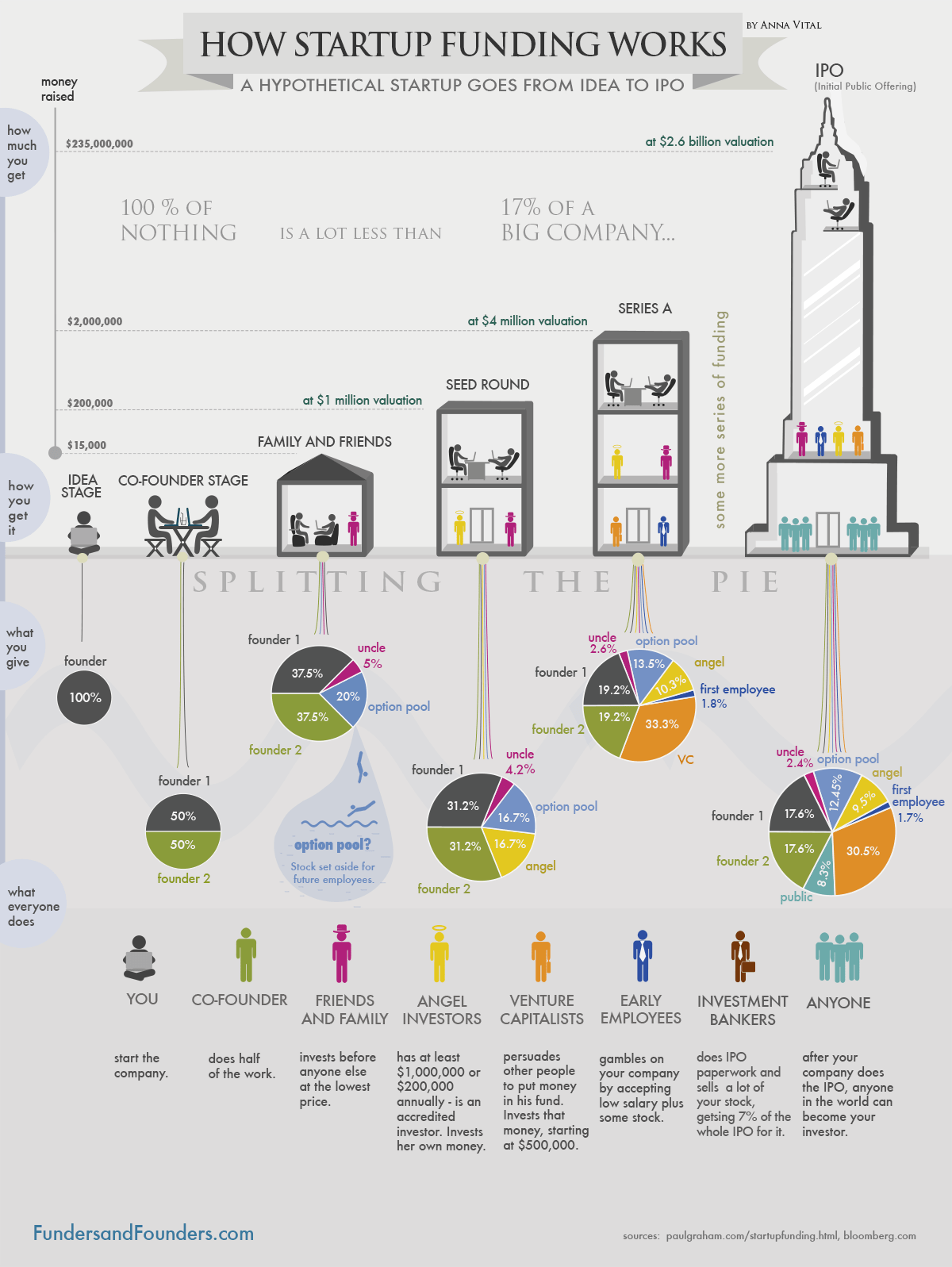
See How Startup Funding Works in this Infographic
Fundraising FAQ
How Much Should You Raise
A practical rule is to raise enough to reach the next meaningful milestone with a buffer. Most founders aim for 12 to 18 months of runway. The right amount depends on burn, hiring plan, growth efficiency, and what metrics investors will expect at the next stage.
How Long Does Fundraising Take
Fundraising often takes longer than founders expect. Timelines depend on intros, market conditions, stage, and traction. Treat fundraising as a focused campaign rather than a side task, because slow inconsistent outreach often drags the round out.
Can a Solo Founder Raise VC
Yes, but it is rarer. Solo founders often need unusually strong traction, unusual domain credibility, or a clear plan to recruit key roles fast. If you are solo, use the process to find strategic investors who can help you build the team.
Conclusion
You now have a more realistic and tactical view of how to raise venture capital for a startup. You understand when VC makes sense, what investors look for, how targeting works, how intros work, what the process looks like, and how to prepare for meetings and diligence. However, this is only the beginning. Execution is what ultimately makes fundraising easier, because strong fundamentals create investor pull.
If you want to go deeper and you already have traction or you are actively building toward it, then we suggest you check out the 14 day free trial of our Online Accelerator Program. There, you will build your company’s foundation, refine positioning, strengthen your go to market plan, learn how to fundraise with clarity, and improve your ability to scale under pressure.