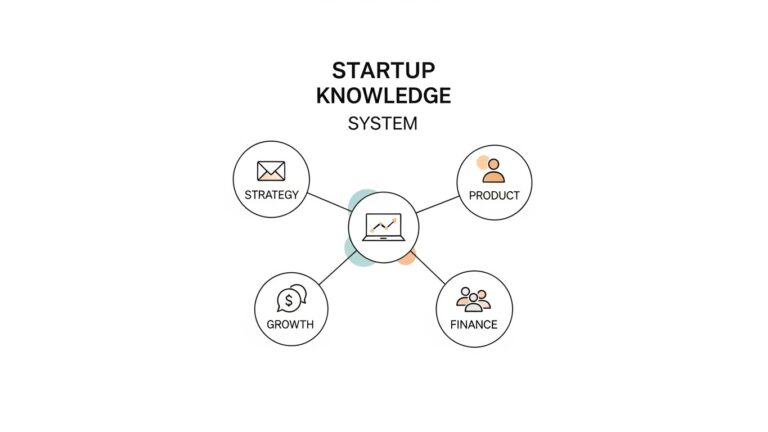
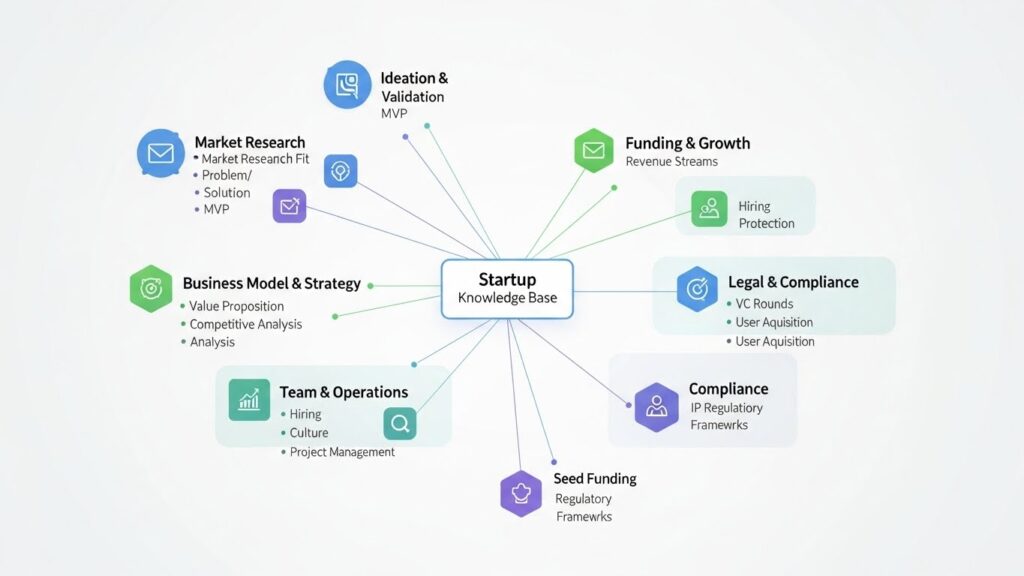
A founder-friendly glossary of the most common startup terms across strategy, product, growth, finance, fundraising, operations, and the startup ecosystem.
A company designed to grow quickly by solving a problem in a scalable way, often under uncertainty.
The person who starts the company and is responsible for shaping its vision, strategy, and early execution.
A partner who starts the company alongside the founder and shares ownership, responsibility, and risk.
The stage where you have clearly identified a real problem and built a solution that meaningfully addresses it.
When a specific market strongly wants your product and adopts it without heavy persuasion.
A clear explanation of why your product exists and why someone should care.
What makes your solution meaningfully different and better than alternatives.
A long-term picture of what you want the company to become and the change it aims to create.
The practical purpose of the company and what it does day to day to move toward its vision.
How your company creates, delivers, and captures value, including how it makes money.
Your plan for how you will reach customers, convert them, and grow adoption.
Something your company can do better than others that is difficult to copy.
A defensible advantage that protects your business from competitors over time.
An assumption you believe to be true about your market, product, or customers that needs testing.
The process of testing assumptions with real users to reduce risk before scaling.
The simplest version of your product that delivers value and allows you to learn from real users.
An early, often incomplete version of a product used to test ideas and gather feedback.
The process of improving a product through repeated cycles of building, testing, and learning.
A prioritized plan outlining what features or improvements you plan to build over time.
The tendency to add too many features, often reducing clarity and slowing progress.
Short-term technical shortcuts that make future development slower or more costly.
Tools that allow you to build software products without writing code.
Platforms that require minimal coding while still allowing customization.
A development approach focused on small, iterative improvements and fast feedback.
An agile framework that organizes work into structured roles, meetings, and short cycles.
A fixed time period, usually one to two weeks, where specific work is planned and completed.
A short description of a feature written from the user’s perspective and goal.
How easy, intuitive, and pleasant a product is to use.
The visual and interactive elements users see and interact with in a product.
A way for different software systems to communicate and share data with each other.
The process of attracting new users or customers to your product.
The total cost required to acquire a single paying customer.
The total revenue a customer is expected to generate over their relationship with your business.
The percentage of users who take a desired action, such as signing up or purchasing.
The steps users move through from first contact to becoming customers.
Creative, data-driven experiments designed to accelerate growth quickly.
A strategy where the product itself drives acquisition, retention, and expansion.
Growth that happens when users naturally refer or invite others.
The rate at which customers stop using or paying for your product.
How well you keep users over time after they first sign up.
The moment a user first experiences meaningful value from your product.
How frequently and deeply users interact with your product.
The process of helping new users understand and start using your product effectively.
A person or organization that has shown interest in your product.
A lead that meets specific criteria indicating they are likely to become a customer.
Marketing efforts designed to create awareness and interest in your product.
How your company is perceived relative to competitors in the minds of customers.
The channels and methods used to get your product in front of users.
A structured view of where potential customers are in the buying process.
Direct contact with potential customers who have not previously engaged with you.
Money earned from selling products or services.
Predictable revenue that repeats over time, often through subscriptions.
The total recurring revenue generated each month.
The yearly equivalent of recurring revenue, commonly used for SaaS businesses.
The speed at which a company spends its cash reserves.
How long a company can operate before running out of cash.
Revenue remaining after subtracting the direct costs of delivering your product.
The profitability of a single customer or transaction.
The point at which revenue equals expenses.
The movement of money in and out of the business.
Building a company using personal funds or revenue instead of outside investment.
When a company consistently earns more than it spends.
A forecast showing how the business is expected to perform financially over time.
Metrics used to measure progress toward business goals.
The single metric that best reflects the core value your product delivers.
The earliest funding stage, often used to validate an idea or build an MVP.
Early funding used to build the product and gain initial traction.
Funding focused on scaling a validated business model.
Institutional investment in high-growth startups in exchange for equity.
An individual who invests personal capital into early-stage startups.
A breakdown of who owns what percentage of the company.
The estimated worth of a company.
The company’s valuation before new investment is added.
The company’s valuation after new investment is included.
The reduction of ownership percentage when new shares are issued.
A document outlining the key terms of an investment.
A simple agreement allowing investors to convert money into equity later.
A loan that converts into equity during a future funding round.
Ownership in a company, usually represented by shares.
A liquidity event where founders and investors sell their ownership, such as an acquisition.
The legal process of forming a company.
A common U.S. corporate structure favored by startups and investors.
A flexible business structure offering personal liability protection.
Creations of the mind such as inventions, brands, and content.
Legal protection for a new invention or process.
Protection for brand names, logos, and slogans.
Adhering to laws, regulations, and industry standards.
The process of recruiting and bringing new team members into the company.
The shared values, behaviors, and norms within a company.
A group of experienced individuals who provide guidance without formal authority.
A governing body responsible for oversight and major decisions.
The systems and processes used to manage and control a company.
A goal-setting framework that aligns objectives with measurable outcomes.
The day-to-day activities required to run the business.
Growing the business efficiently without breaking systems or culture.
A program that helps very early startups develop ideas and foundations.
A structured program that helps startups grow quickly through mentorship and resources.
A significant change in strategy based on new learnings.
When a product becomes more valuable as more people use it.
The way a founder understands problems, makes decisions, and navigates uncertainty.
Now that you’re familiarized with some of the most important terms, try using our article on How to Start a Startup so you can better understand the process of startup creation and everything that comes with it. Additionally, if you have a startup idea, then you should try out our 14-day free trial for our Incubator Program so you can start trying our Idea Validation Course to validate your idea.