In-Depth Accelerator Curriculum
Build capability across the major disciplines involved in operating, launching, growing, and funding an early-stage company.
An equity-free online accelerator combining unusually deep startup education, execution-based worksheets, purpose-built AI software, startup kits, tools, and resources to help you build and grow a stronger company.
The Accelerator combines structured founder education with the execution tools, software, resources, and support you need to apply what you’re learning to your own startup.
Build capability across the major disciplines involved in operating, launching, growing, and funding an early-stage company.
Turn lessons into work on your actual startup through structured exercises, decisions, plans, systems, and implementation.
Get greater access to StartupDevKit’s purpose-built AI tools for startup planning, roadmaps, experimentation, investor materials, and ongoing execution.
Unlock Accelerator-stage Startup Kits plus deeper access to specialized libraries, templates, tools, and founder resources.
Work across the core areas that move an early-stage company forward—from product and positioning through customer acquisition, growth, and capital readiness.
The Accelerator doesn’t skim across startup topics. Its lessons go deep into the individual disciplines founders need to understand as they build and grow an early-stage company.
Many lessons are substantial enough to function like focused mini-courses on their subject matter—giving you the context, frameworks, strategic thinking, and practical guidance needed to understand not only what to do, but when, why, and how to do it.
Inside an Accelerator Lesson
Lessons combine education with structured execution so founders can move from understanding a subject to using it inside their companies.
StartupDevKit connects education with execution so the value of the Accelerator extends beyond finishing lessons.
Build deeper understanding across startup strategy, operations, product, marketing, customer acquisition, growth, metrics, fundraising, and the other disciplines required to build an early-stage company.
Use execution-based worksheets and practical resources to turn concepts into decisions, plans, systems, processes, experiments, and tangible startup work.
Use your expanded AI Startup OS access, Accelerator Startup Kits, resource libraries, templates, tools, and other membership resources to support execution beyond the curriculum.
The curriculum progresses from company and MVP foundations through product execution, go-to-market, customer systems, sustainable growth, and capital readiness—helping you develop different parts of the company without treating them as isolated disciplines.
Startups don’t fail for only one reason. They break down across product-market fit, team composition, product quality, customer understanding, marketing, competition, business-model viability, capital, and execution. StartupDevKit turns those recurring failure patterns into structured learning and execution pathways founders can work through before weaknesses compound.
No accelerator can eliminate startup risk. The goal is to help you identify common failure modes earlier, make better-informed decisions, and build stronger systems around the areas that most often derail early-stage companies.
Phase 01
Establish the operating, team, product, legal, marketing, technical, and founder foundations needed to build the company on stronger systems from the beginning.
8 Modules
01
02
03
04
05
06
07
08
Startup execution depends on the people making decisions and doing the work. Skill gaps, unclear roles, co-founder friction, weak management systems, and poor governance can become company-level problems.
A startup can create something useful and still fail to become a durable business. Founders need a coherent way to create, deliver, and capture value while understanding the economics behind growth.
Phase 02
Move from foundation into market execution by strengthening the product, positioning, conversion systems, customer experience, launch readiness, lifecycle infrastructure, measurement, and early acquisition.
7 Modules
09
10
11
12
13
14
15
Weak product execution can undermine even a promising market opportunity. Founders need disciplined product development, testing, quality control, and a way to learn from real usage.
A startup can’t create traction if the right customers never understand, discover, or engage with the offer. Marketing has to connect positioning, channels, distribution, lifecycle systems, and measurable acquisition.
Customer signals are operating data. Ignoring feedback, behavior, retention, objections, and changing needs can allow a startup to drift away from the people it depends on.
Phase 03
Build beyond launch with systems for sustainable growth, external leverage and credibility, capital strategy, and deliberate investor access.
4 Modules
16
17
18
19
Competition isn’t just about watching rival companies. It’s about understanding where the market is moving, why customers choose alternatives, how your positioning holds up, and where you can build leverage that compounds.
Running out of capital appeared in 70% of the recent shutdowns analyzed by CB Insights, but the report notes that capital exhaustion is usually the final cause of death rather than the underlying problem. Product-market fit, economics, execution, timing, and financing decisions often determine how the story gets there.
This public syllabus shows the complete lesson-by-lesson structure of the Accelerator. Members also receive the working program syllabus and associated worksheet guidance to help them progress through the curriculum and apply the material to their own companies.
Phase 01
Module 01
Module 02
Module 03
Module 04
Module 05
Module 06
Module 07
Module 08
Phase 02
Module 09
Module 10
Module 11
Module 12
Module 13
Module 14
Module 15
Phase 03
Module 16
Module 17
Module 18
Module 19
Instead of learning startup disciplines as disconnected topics, you’ll repeatedly connect strategy, product, customers, operations, growth, measurement, and capital decisions back to the systems and priorities of your own startup.
The Accelerator is self-paced because founders aren’t all building under the same circumstances.
Full-time founders can move through the program intensively while building alongside it. Founders balancing a startup with work, school, or other responsibilities can take longer and give the implementation work the time it deserves.
Either way, the goal isn’t to race through lessons. It’s to use the program to make meaningful progress inside the company you’re actually building.
✓
✓
✓
Your membership expands your access to StartupDevKit’s purpose-built software, Accelerator-stage Startup Kits, founder intelligence, resource libraries, and tools so you can keep executing as your company evolves.
Accelerator membership also includes two additional StartupDevKit courses designed to help founders strengthen important parts of the company beyond the core 45-lesson Accelerator curriculum.
Go deeper into building, validating, launching, and evolving an MVP using product-led principles designed to help you reduce unnecessary build risk and create stronger feedback loops between the product and its users.
Build with greater financial and operational discipline through guidance on lean execution, resource constraints, revenue, workload, automation, KPIs, sustainable growth, and the transition from part-time to full-time company building.
Accelerator members receive expanded access to StartupDevKit’s purpose-built AI Startup OS, giving you more capacity to plan, analyze, prioritize, experiment, and prepare for what comes next.
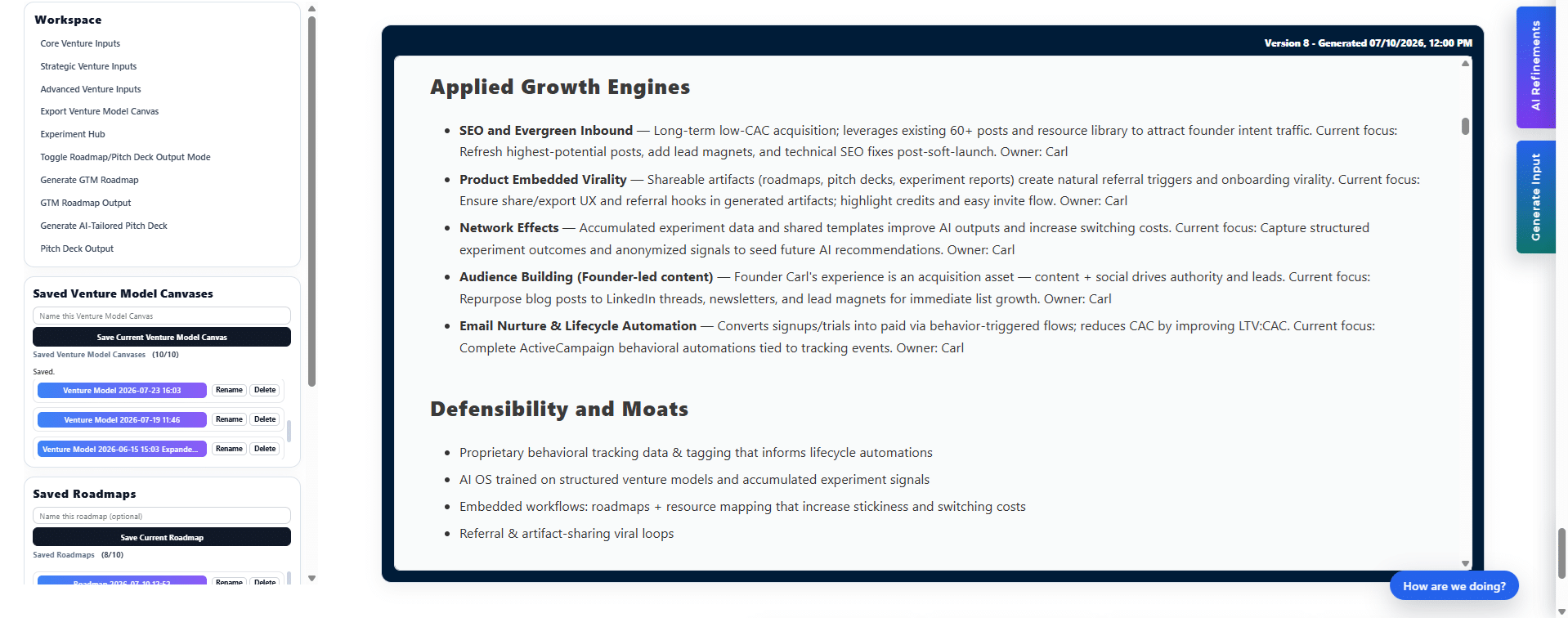
Instead of working from generic AI responses, the AI Startup OS uses structured context about your company, stage, customers, product, market, growth strategy, resources, metrics, and other venture inputs to support more relevant startup work.
01
02
03
04
Accelerator Access
Venture Context
Turn Context Into Execution
◇
↗
◎
▣
Turn structured venture context into prioritized strategy, growth systems, defensibility analysis, and execution guidance.
The Accelerator gives you access to practical assets and curated intelligence designed to reduce research friction, close knowledge gaps, and help you move more quickly from deciding what to do to actually doing it.
Unlock Startup Kits designed for more advanced company-building work, giving you structured starting points, templates, frameworks, and practical resources for important startup activities.
Research venture capital firms and build a more informed investor target list instead of relying on scattered searches, disconnected spreadsheets, and random outreach.
Explore curated AI tools, platforms, resources, and practical applications that can help founders use AI more effectively across startup execution.
Access curated guides, templates, frameworks, references, and external resources across the different areas founders need to navigate while building a company.
Go deeper into customer acquisition, marketing channels, growth systems, distribution, and other resources that support the work of finding and retaining customers.
Discover software, platforms, and services across startup functions so you can evaluate the tools available to support the systems you’re building.
The value of the Accelerator isn’t any single lesson, worksheet, tool, or resource. It’s having multiple layers of company-building support available as different problems emerge.
01
02
03
04
The Accelerator is designed for founders who want meaningful structure, deeper execution support, and a more rigorous way to build and grow an early-stage company.
The Accelerator is self-paced, so your timeline can reflect the reality of the company and life around it.
Work through the Accelerator according to the needs and realities of your startup instead of being forced through a fixed cohort calendar.
StartupDevKit doesn’t take ownership in your company. You keep 100% of your equity while using the program and platform.
Lessons, worksheets, AI tools, Startup Kits, libraries, and other resources are designed to help you apply what you’re learning to your actual company.
Return to relevant lessons, tools, resources, and systems as your startup evolves and new company-building challenges emerge.
Accelerator members can apply for individual mentoring with StartupDevKit’s founder for targeted support on startup strategy, decisions, execution challenges, and roadblocks.
Mentoring is application-based and offered separately from membership so sessions can remain focused on founders with a specific challenge where direct feedback can be useful.
Founders building an early-stage company have more ways than ever to get information, advice, automation, and outside support. The StartupDevKit Accelerator brings education, AI-powered venture planning, execution systems, and founder resources together in one structured company-building environment.
| Path | Cost | Structure & Clarity | Support | Execution Focus | Typical Tradeoff / Outcome |
|---|---|---|---|---|---|
| DIY execution with scattered content | Free to low | Low | Self-guided | Reactive problem-solving | Flexible and inexpensive, but priorities, systems, and startup disciplines can become fragmented as new problems emerge. |
| General startup courses | Low to medium | Medium | Limited | Education-focused | Can build useful founder knowledge, but individual topics may remain disconnected from the systems and priorities of one specific company. |
| General-purpose AI chatbots | Free to low | Low to medium | Conversational | Advice, research, ideation, and problem-solving | Fast and flexible, but startup guidance can become fragmented without persistent venture context, structured priorities, or an integrated company-building system. |
| AI agents and autonomous workflows | Low to medium | Medium | Automated | Task execution and workflow automation | Can dramatically accelerate research and execution, but still require strong objectives, reliable context, appropriate oversight, and sound strategic decisions. |
| Traditional cohort-based accelerators | Varies; some take equity | High | High | Cohort milestones, mentoring, networking, and company growth | Can provide valuable mentorship, accountability, networks, and investor exposure, but programs may involve selective admission, fixed schedules, geographic constraints, or equity requirements. |
| Consultants and fractional specialists | High to very high | High | Specialized | Expert-led strategy or execution | Can provide deep expertise in specific functions, but costs can rise quickly and individual specialists may not provide an integrated operating system across the company. |
|
StartupDevKit Accelerator |
Membership-based | High | Structured curriculum + AI Startup OS + founder resources | Product, operations, go-to-market, customers, growth, measurement, and fundraising | A self-paced, equity-free company-building system that connects education, venture context, AI software, execution resources, and strategic frameworks while keeping execution founder-led. |
The advantage isn’t simply having more startup information.
It’s connecting product, customers, operations, go-to-market, growth, measurement, capital strategy, AI-powered venture planning, and founder resources into a more coherent execution system.
Both Accelerator plans include the core Accelerator experience, with access designed for either an individual founder or a founding team.
For founders building and operating their startup individually.
Start Your 10-Day Free Trial →
Collaborative Access
For co-founders and startup teams working through the Accelerator together.
Start Your 10-Day Free Trial →
The Accelerator is intentionally flexible, but it’s designed for founders serious about applying the program to a real startup.
No. Full-time founders can use the Accelerator intensively, while founders balancing work, school, or other responsibilities can move through the same program at a more sustainable pace.
The curriculum can be approached as an intensive accelerator path, but there’s no requirement to finish on a fixed schedule. The right timeline depends on how much time you can devote to the startup and how much implementation work each stage requires.
The Accelerator is best suited to founders who’ve moved beyond basic idea exploration and are preparing to build, actively building, launching, or growing an early-stage company. Founders who still need to validate the core opportunity may be better served by the StartupDevKit Incubator first.
No. StartupDevKit takes no equity in your company. Your membership doesn’t require you to give StartupDevKit ownership in your company.
No. The current Accelerator is self-paced rather than cohort-based, giving founders ongoing access without forcing every company through the same calendar or milestones.
Yes. Accelerator Team membership is designed for founding teams that want to use StartupDevKit collaboratively while building the company together.
Get the curriculum, execution-based worksheets, AI tools, Startup Kits, founder intelligence, resource libraries, and broader platform support designed to help you build and grow a stronger company.