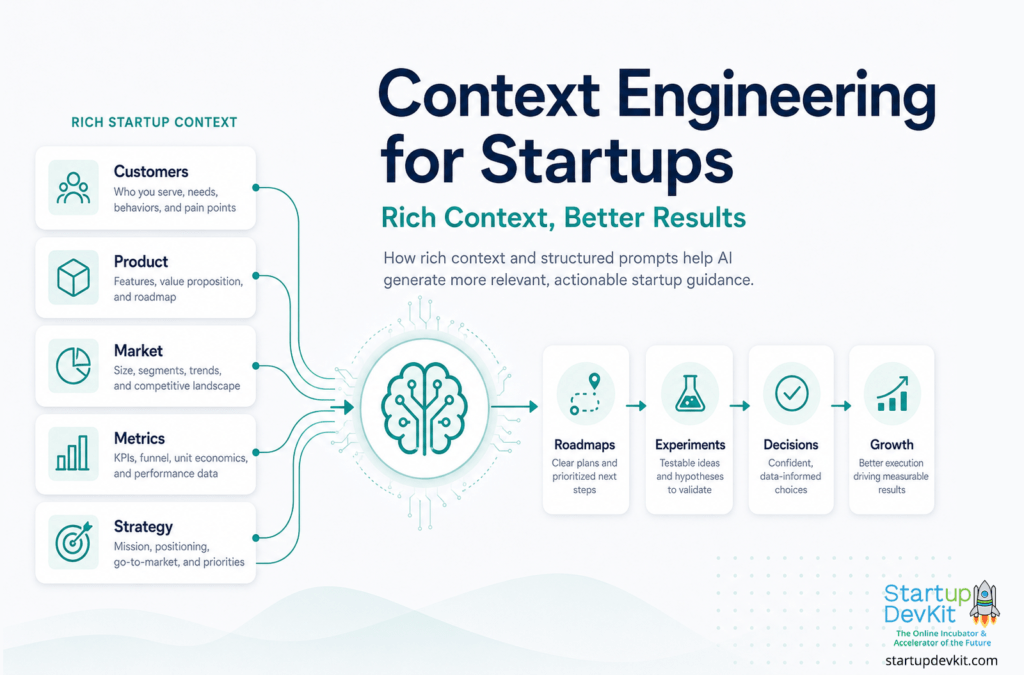

Context engineering for startups is becoming essential as founders rely more heavily on AI for planning, research, marketing, experimentation, and decision-making.
AI adoption is widespread, yet many systems still produce generic or poorly grounded results. Gartner predicts that 60% of AI projects unsupported by AI-ready data will be abandoned through 2026. The problem is often not the AI model or even the prompt. It is the quality of the information the AI receives.
When an AI system lacks meaningful context about a startup’s customers, product, market, constraints, evidence, and priorities, it fills the gaps with broad assumptions. The result may sound polished while offering little that is specific to the venture.
StartupDevKit has developed practical expertise in this area by building an AI Startup OS that uses a structured Venture Model to support roadmaps, experiments, metrics, learning loops, and investor-ready outputs. We also use these systems to plan and improve StartupDevKit itself.
The principle behind this article is simple:
Rich context + structured prompts = more relevant, specific, and actionable AI results.
1. Why Do AI Systems Give Businesses Generic Answers?
AI systems often produce generic business advice because they are asked to reason about companies they barely understand.
A founder might ask:
How should we acquire our first customers?
The AI may recommend defining an ideal customer profile, publishing content, conducting founder-led outreach, building partnerships, testing paid advertising, and tracking conversion rates.
None of those suggestions are necessarily wrong. The problem is that the AI may not know:
- What the company sells
- Who the target customer is
- Whether the product has launched
- How much the company can spend
- How much time the founders have available
- Which channels have already been tested
- What results those tests produced
- Whether the company sells to consumers or businesses
- How long the buying process takes
- What the founders are currently trying to learn
Without that context, the AI must fill the gaps with broad patterns. The response may be statistically plausible without being sufficiently grounded in the company’s circumstances.
Consider a fictional example. Imagine a bootstrapped B2B SaaS startup that helps boutique agencies collect client feedback and approvals. It has one part-time founder, a pre-revenue product, a $500 monthly marketing budget, and ten completed customer interviews.
If the founder simply asks how to grow the startup, the AI might recommend paid advertising, search engine optimization, partnerships, webinars, content marketing, and outbound sales. That is a reasonable list, but it does not help the founder determine what to do first.
With richer context, the AI could instead recommend a focused four-week test involving direct outreach to boutique agency owners, participation in two relevant professional communities, five additional discovery interviews, and concierge onboarding for a small pilot group. It might also deprioritize paid advertising until the founder has stronger messaging and a reliable conversion baseline.
The second recommendation is not better because the AI suddenly became more intelligent. It is better because the AI understands more about the venture.
This matters especially for startups. Established companies may have enough staff, money, and operational stability to absorb an imperfect recommendation. Startups usually operate with limited runway, incomplete information, and little room for wasted effort.
A generic recommendation can send a founder toward the wrong customer segment, channel, feature, experiment, or metric. The cost may be weeks of lost time, unnecessary spending, or a strategic decision based on incomplete reasoning.
Better prompts can improve the output, but prompts alone cannot supply company knowledge that was never provided.
2. What Is Context Engineering?
Context engineering is the deliberate process of identifying, structuring, maintaining, and delivering the information an AI system needs to perform a task effectively.
That information may include:
- Facts about the company
- Customer research
- Product details
- Strategic priorities
- Constraints
- Historical decisions
- Experiment results
- Metrics and milestones
- Assumptions and hypotheses
- Communication preferences
- Relevant documents and data
- The immediate goal of the task
Context engineering is not simply the act of pasting more information into a chat window. It involves deciding what information matters, how it should be organized, which sources should be trusted, what has changed, and what should be included for a particular task.
A well-contextualized AI system should be able to distinguish between:
- A confirmed fact and an untested assumption
- A current priority and an outdated initiative
- A target customer and a secondary use case
- A strategic decision and an idea still under consideration
- A successful experiment and an inconclusive result
- A hard constraint and a flexible preference
The purpose is not to make the AI know everything. The purpose is to make the most relevant information available when it is needed.
Why Is Context Engineering Important?
Large language models generate responses based on their general training and the information available during an interaction. When business context is thin, incomplete, outdated, or contradictory, the output is more likely to be generic, inconsistent, or poorly aligned with the company’s needs.
Rich, organized context can help AI produce responses that are:
- More relevant to the company
- More consistent with prior decisions
- Better aligned with current priorities
- More sensitive to actual constraints
- More useful for execution
- Less repetitive
- Easier for a founder or team to evaluate
Context engineering can also reduce the need to repeatedly explain the business from the beginning. Instead of treating each AI conversation as an isolated interaction, the company can preserve and reuse its accumulated knowledge.
Who Should Care About Context Engineering?
Context engineering is useful for anyone using AI to perform work that depends on organizational knowledge, including:
- Founders and startup teams
- Product managers
- Marketers and sales teams
- Consultants and agencies
- Investors and analysts
- Operators and researchers
- Companies building AI agents
- Teams creating internal AI systems
The more a task depends on company-specific information, the more important context engineering becomes.
3. How Is Context Engineering Different From Prompt Engineering?
Prompt engineering and context engineering are closely related, but they solve different problems.
What Is Prompt Engineering?
Prompt engineering focuses on how a task is communicated to an AI system.
A strong prompt may specify:
- The objective
- The intended audience
- The desired output
- The required format
- The appropriate tone
- The relevant constraints
- The steps the AI should follow
- The criteria for a successful response
For example:
Create a four-week customer discovery plan for an early-stage B2B software startup. Include weekly objectives, founder actions, interview targets, learning goals, and decision criteria.
This is more useful than asking:
Help me with customer discovery.
The structured prompt gives the AI a clearer task.
What Is Context Engineering in Practice?
Context engineering focuses on what the AI knows when completing that task.
For the customer discovery plan, useful context might include:
- The product concept
- The customer problem being investigated
- The suspected buyer and end user
- Previous customer interviews
- Current assumptions
- The founder’s existing network
- Available time and budget
- The target launch date
- The decisions the research should inform
Prompt engineering improves the instructions. Context engineering improves the informational environment in which those instructions are carried out.
How Do Context Engineering and Prompt Engineering Differ?
A prompt tells the AI what to do.
Context helps the AI understand what it is doing that work for.
A structured prompt without rich context may produce an organized but shallow response. Rich context without a clear prompt may produce a relevant but unfocused response.
They work best together.
4. Why Do Rich Context and Structured Prompts Work Better Together?
The quality of an AI response depends on both the quality of the instructions and the quality of the information available.
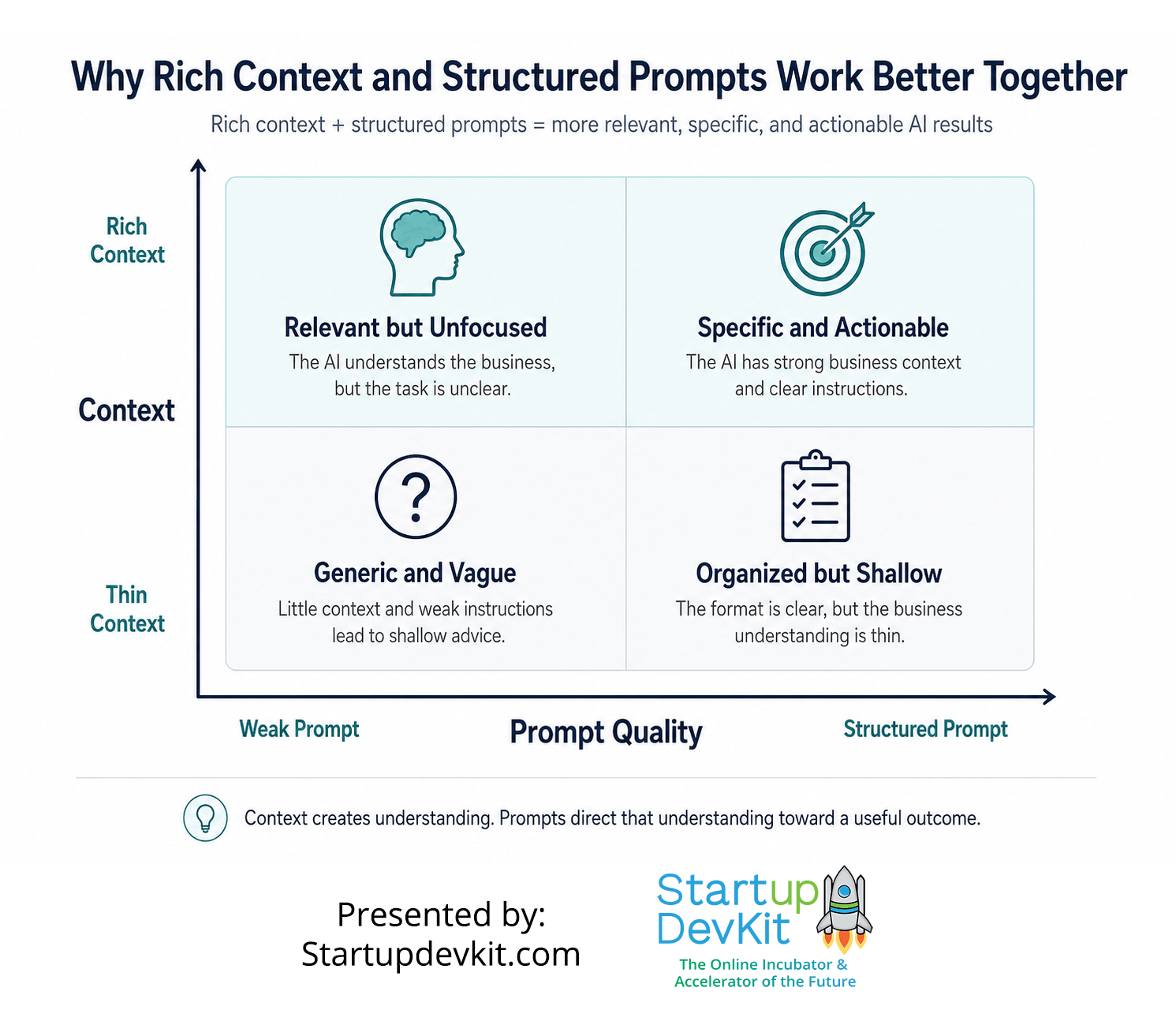
Thin Context and a Weak Prompt
This is the least effective combination.
A founder asks:
How do I grow my startup?
The AI has little company information and no clearly defined task. It will usually respond with broad advice about product-market fit, customer acquisition, content, partnerships, retention, and analytics.
Thin Context and a Structured Prompt
The output may appear professional because the format is clearly specified, but the recommendations may still lack depth.
A detailed request for a 90-day growth plan will not produce a truly company-specific strategy when the AI knows almost nothing about the company.
For our fictional B2B SaaS startup, a structured prompt might produce a well-organized calendar containing paid campaigns, webinars, blog posts, and sales outreach. The plan may be coherent while still exceeding the founder’s budget, time, and current level of validation.
Rich Context and a Weak Prompt
The AI may understand the business but still be unsure what kind of response is needed. It might provide a thoughtful answer that is too broad, too long, or poorly prioritized.
Rich Context and a Structured Prompt
This is where AI becomes significantly more useful.
The system understands the company, customers, product, constraints, evidence, history, and priorities. It also receives a clear instruction defining the task, desired outcome, timeframe, and output format.
For our fictional startup, the founder could ask:
Using our current customer interviews, $500 monthly budget, part-time availability, and pre-revenue stage, create a four-week customer acquisition experiment. Focus on learning which agency segment has the strongest need. Include weekly actions, outreach volume, success criteria, and a decision rule.
The resulting answer is more likely to reflect the actual business rather than a generic startup archetype.
This is the core of effective AI collaboration:
Context creates understanding. Prompts direct that understanding toward a useful outcome.
5. What Business Context Does AI Need?
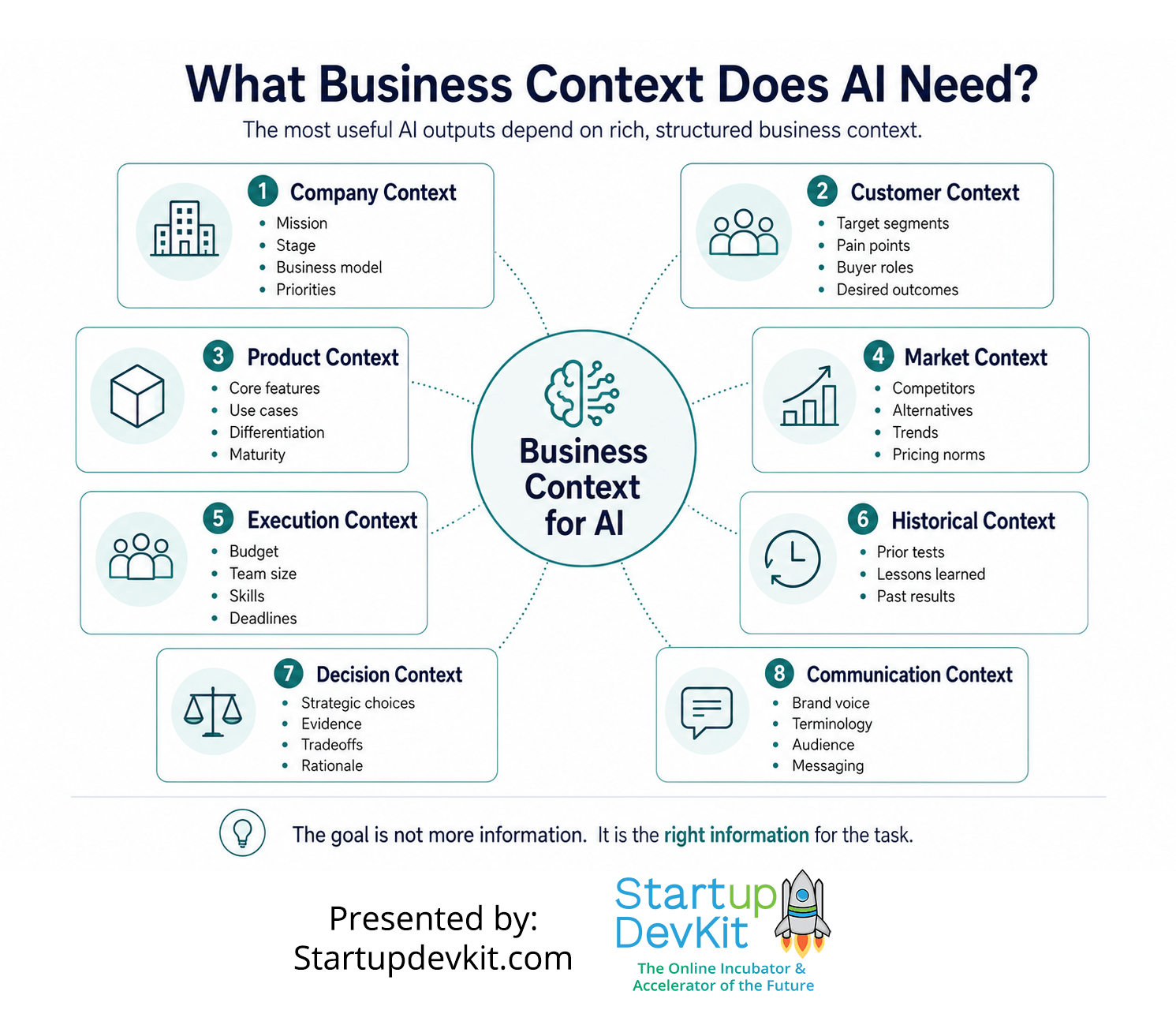
The context required depends on the task, but several categories are especially valuable for business AI systems.
Company Context
Company context explains what the business is and what it is trying to accomplish.
It may include:
- Mission and vision
- Company stage
- Business model
- Revenue model
- Value proposition
- Founding team
- Available resources
- Current objectives
- Strategic priorities
A pre-launch startup with one part-time founder should not receive the same recommendations as a funded company with an established product, a sales team, and recurring revenue.
Customer Context
Customer context helps AI understand who experiences the problem, who uses the product, who influences the purchase, and who makes the final buying decision.
It can include:
- Customer segments
- Ideal customer profiles
- User roles
- Buyer and budget-owner roles
- Jobs to be done
- Pain points
- Desired outcomes
- Buying triggers
- Objections
- Customer interview findings
- Behavioral evidence
This distinction is especially important in business-to-business markets, where the user, buyer, decision-maker, and budget owner may be different people.
Product Context
Product context explains what the company is building and how it creates value.
It may include:
- Product description
- Core features
- Primary use cases
- User journey
- Product maturity
- Existing assets
- Differentiation
- Technical limitations
- Roadmap priorities
- Product dependencies
Without this information, AI may recommend features or strategies that conflict with the product’s actual direction.
Market Context
Market context helps AI place the business within its broader environment.
It can include:
- Industry and market category
- Direct competitors
- Indirect alternatives
- Market trends
- Pricing norms
- Regulatory considerations
- Distribution patterns
- Customer expectations
- Timing factors
- Opportunities and threats
Market context should include not only direct competitors, but also the tools, manual processes, or existing behaviors customers currently use instead of the product.
Execution Context
Execution context explains what the company can realistically do.
It may include:
- Available budget
- Team size
- Founder availability
- Team skills
- Technology and tools
- Sales capacity
- Marketing capacity
- Deadlines
- Dependencies
- Operational constraints
A recommendation is not actionable merely because it is strategically sound. It must also fit the company’s resources and capabilities.
Historical Context
Historical context helps AI understand what has already happened.
It may include:
- Previous strategies
- Earlier product versions
- Customer discoveries
- Past experiments
- Campaign performance
- Successful initiatives
- Failed initiatives
- Changes in direction
- Lessons learned
Suppose our fictional startup already tested broad, automated LinkedIn outreach and received almost no qualified responses. If that result is preserved as context, the AI can avoid recommending the same tactic without modification. It might instead recommend narrower, personalized outreach based on specific interview findings.
Decision Context
Decision context explains what choices were made and why.
It can include:
- The decision
- The alternatives considered
- The supporting evidence
- The assumptions involved
- The tradeoffs accepted
- The decision date
- The decision owner
- The conditions that would justify revisiting it
This prevents the company’s reasoning from disappearing after a meeting, document, or AI conversation ends.
Communication Context
Communication context helps AI produce outputs that fit the company and the intended audience.
It may include:
- Brand voice
- Tone
- Preferred terminology
- Messaging principles
- Audience sophistication
- Formatting preferences
- Claims the company avoids
- Positioning language
- Internal naming conventions
This is useful for marketing, investor communications, customer support, product copy, sales materials, and internal documentation.
6. How Should Business Context Be Structured?
Having information is not the same as having usable context.
A folder full of documents may contain important organizational knowledge, but the information can still be difficult for an AI system to interpret. Documents may overlap, conflict, lack dates, or reflect different periods in the company’s development.
Structured context makes information easier to evaluate, retrieve, and apply.
Separate Facts, Assumptions, and Hypotheses
These categories should not be treated as interchangeable.
A fact is something supported by reliable evidence.
Ten agency owners completed customer interviews, and seven described delayed client approvals as a recurring problem.
An assumption is something currently believed but not yet sufficiently validated.
Agency owners consider the approval problem urgent enough to pay for a dedicated solution.
A hypothesis is a testable prediction.
Personalized outreach to 50 boutique agency owners will generate at least five qualified demonstrations for a concierge pilot.
When these distinctions are unclear, AI may present uncertain beliefs as established truth.
Connect Business Claims to Evidence
Business context becomes more useful when important claims are supported by evidence.
Evidence may include:
- Customer interviews
- Product usage data
- Sales conversations
- Conversion rates
- Retention data
- Experiment outcomes
- Survey responses
- Market research
- Financial results
The AI should be able to understand not only what the company believes, but why it believes it and how strong the supporting evidence is.
Record Constraints Explicitly
Constraints shape the range of viable recommendations.
Examples include:
- A limited monthly budget
- A regulatory requirement
- A fixed product launch deadline
- A small technical team
- A founder working part-time
- A long enterprise sales cycle
- A dependency on a third-party platform
When constraints are not documented, AI may generate plans that are theoretically attractive but operationally unrealistic.
Identify Current Priorities
Companies usually have more possible actions than they can execute.
Useful context should identify:
- The current objective
- The most important metric
- The primary bottleneck
- The decision that needs to be made
- The relevant timeframe
- What is intentionally being deprioritized
This helps AI recommend what matters now rather than generating an undifferentiated list of ideas.
Maintain an Authoritative Source of Truth
Companies often store information across documents, spreadsheets, email threads, project-management tools, messaging platforms, AI conversations, and individual memories.
Over time, different versions of the company story can emerge.
A source of truth provides an authoritative representation of the company’s current understanding. It does not need to contain every detail, but it should clarify the most important facts, assumptions, priorities, decisions, evidence, and constraints.
AI memory can help preserve information across interactions, but memory alone is not a substitute for good knowledge management. The remembered information must still be organized, current, relevant, and distinguishable from outdated beliefs.
Resolve Contradictory Context
Contradictory context can confuse an AI system and weaken its recommendations.
For example, an older document for our fictional startup might describe independent freelancers as the primary customer, while the current venture strategy focuses on boutique agencies. Both statements may have been accurate at different times, but the AI needs to know which one reflects the current strategy and why it changed.
Contradictions should be:
- Corrected
- Dated
- Explained
- Marked as unresolved when necessary
- Associated with the relevant company stage
Context should evolve as the business evolves.
7. How Much Context Should an AI System Receive?
More context is not always better.
An AI system may perform worse when it receives large amounts of irrelevant, outdated, repetitive, or contradictory information. Important details can become harder to identify when they are surrounded by noise.
The objective is not to provide the maximum possible volume of information.
The objective is to provide the most relevant, current, and authoritative context for the task.
Can Too Much Context Hurt AI Performance?
Yes. Excessive context can introduce:
- Irrelevant details
- Conflicting instructions
- Outdated strategies
- Duplicate information
- Weak or unverified evidence
- Unrelated documents
- Ambiguity about priorities
For example, an AI system creating a homepage value proposition may need the target customer, pain point, product, differentiation, desired outcome, brand voice, and current positioning.
It probably does not need every past experiment, engineering note, financial projection, meeting transcript, and internal conversation.
Why Do Context Windows Matter?
A context window is the amount of information an AI model can consider during a particular interaction.
Larger context windows allow AI systems to process more information, but capacity alone does not guarantee quality. A model can technically receive a long document while still failing to identify the facts most relevant to the task.
Organization, prioritization, and relevance remain important.
Why Does Retrieval Matter?
Retrieval is the process of selecting information that is relevant to the current task.
Instead of supplying the company’s entire body of organizational knowledge every time, an AI system can receive the subset most likely to help with the request.
A pricing task for our fictional startup might need:
- Target customer segments
- Customer willingness-to-pay evidence
- Competitor and alternative pricing
- Product differentiation
- Estimated customer value
- Unit economics
- Revenue objectives
A customer onboarding task would require a different set of context.
Why Is Relevance More Important Than Volume?
Good context engineering answers four questions:
- What does the AI need to know?
- Which information is most trustworthy?
- What information is current?
- What is relevant to this particular task?
Effective context is selective, not indiscriminate.
8. How Can Startups Build Rich Business Context?
Startups do not need an elaborate AI infrastructure to begin practicing context engineering.
They can start by documenting the venture in a structured and consistent way.
Create a Canonical Venture Profile
A canonical venture profile should summarize the company’s current understanding of:
- The customer problem
- The proposed solution
- Target customers
- The business model
- The value proposition
- The market
- Competition and alternatives
- Differentiation
- The company stage
- Metrics and milestones
- Risks and assumptions
- Resources and constraints
- Strategic priorities
This profile becomes a foundation for future AI-assisted work.
Capture Customer Learning
Customer knowledge should not remain trapped in interview notes or founder memory.
Record:
- Who was interviewed
- What problem the person described
- How the problem is currently solved
- How frequently the problem occurs
- What outcomes the customer wants
- What objections were raised
- What evidence supports or weakens the startup’s assumptions
Over time, recurring patterns can be distinguished from isolated comments.
Record Strategic Decisions
Important decisions should include the reasoning behind them.
For example:
We are initially targeting boutique agencies rather than independent freelancers because interviews revealed more frequent approval delays, higher potential account value, and a stronger need for standardized client workflows.
This gives future AI interactions more useful information than simply recording the selected segment.
Track Assumptions and Hypotheses
Startups operate under uncertainty. Their context should make that uncertainty visible.
A founder may believe:
- A particular customer segment has the strongest pain
- A specific feature will improve activation
- A marketing channel can produce customers affordably
- A pricing model will increase conversion
- A workflow improvement will increase retention
These beliefs should be treated as hypotheses until evidence supports them.
Preserve Experiment History
Each experiment should record:
- The hypothesis
- The action taken
- The target audience
- The activity or sample size
- The metric
- The success threshold
- The result
- The interpretation
- The next decision
This allows AI to reason from the startup’s accumulated evidence rather than repeatedly suggesting disconnected tactics.
Maintain Metrics and Milestones
AI recommendations should reflect the company’s actual stage and performance.
Useful metrics may include:
- Customer interviews completed
- Signups
- Activation
- Conversion
- Revenue
- Retention
- Engagement
- Customer acquisition cost
- Sales-cycle length
- Experiment velocity
Milestones provide additional context about what the company is trying to accomplish next.
Document Resources and Constraints
Startups should clearly record:
- Team availability
- Budget
- Skills
- Technology
- Access to potential customers
- Distribution assets
- Existing partnerships
- Deadlines
- Dependencies
These inputs help AI distinguish between an attractive idea and a feasible one.
Update Context Over Time
Startup context is not static.
Customer segments change. Products evolve. Experiments invalidate assumptions. New competitors emerge. Resources expand or contract. Strategic priorities shift.
Context should be updated whenever new evidence or decisions materially change the company’s understanding.
9. What Are the Business Benefits of Context Engineering?
Context engineering improves more than the quality of individual AI responses. It can strengthen how a company thinks, learns, and executes.
More Relevant AI Outputs
AI can tailor recommendations to the company’s stage, customers, product, evidence, resources, and goals.
Better Planning
Plans become more realistic when they account for constraints, dependencies, milestones, previous results, and available resources.
Stronger Decision-Making
AI can help compare alternatives using the company’s actual priorities and evidence rather than relying exclusively on generic frameworks.
Less Repetitive Briefing
Founders and employees do not need to repeatedly reconstruct the company’s background for every task or AI interaction.
Faster Execution
Teams can move more quickly from company knowledge to plans, experiments, business assets, and decisions.
Improved Knowledge Continuity
Important knowledge is less likely to disappear when a conversation ends, an employee leaves, or a founder forgets why a decision was made.
Better Organizational Learning
Experiments, evidence, outcomes, and decisions can build upon one another. The company develops an increasingly useful record of what it has learned.
More Effective AI Collaboration
AI becomes less like a disconnected question-and-answer tool and more like a collaborator that understands the company’s operating environment.
10. Why Do Startups Have an Advantage in Context Engineering?
Startups may have fewer resources than established companies, but they often have an important advantage: they can build cleaner information systems from the beginning.
Startups Can Start Clean
Large organizations frequently inherit years of duplicated documents, departmental silos, outdated policies, conflicting data, legacy systems, and undocumented decisions.
A startup can establish structured company context before that fragmentation develops.
Startups Have Less Organizational Complexity
Early teams usually have fewer departments, products, regions, approval processes, and legacy systems.
This can make it easier to define authoritative information and keep it current.
Startups Operate Through Faster Learning Loops
Startups continually move through cycles of:
- Assumption
- Experiment
- Evidence
- Decision
- Action
- Measurement
- Revision
These cycles naturally generate the type of context AI systems need.
For our fictional startup, a customer outreach experiment may show that agencies with five to fifteen employees respond much more frequently than solo consultants. That result can update the target customer definition, shape the next product demonstration, change the outreach message, and influence the next roadmap priority.
The experiment does not merely produce a metric. It enriches the startup’s business context.
Startups Can Build AI-Native Operating Habits
Instead of adding AI to a fragmented organization later, startups can incorporate AI into planning, research, experimentation, documentation, and decision-making from the beginning.
An AI-native startup is not merely a company that uses AI tools. It is a company that structures its information and workflows so AI can contribute meaningfully across the organization.
Context Can Become a Compounding Asset
Each customer conversation, experiment, decision, and result can strengthen the company’s context.
As the context becomes richer, AI outputs can become more relevant. Better outputs can support better decisions. Better decisions create new evidence, which further improves the company’s understanding.
This creates a compounding learning system.
11. How Does StartupDevKit Apply Context Engineering?
StartupDevKit applies context-engineering principles to startup planning, execution, experimentation, and venture intelligence.
Its Venture Model provides founders with a structured representation of their company. Rather than treating each AI interaction as an isolated request, the Venture Model organizes important business context such as the startup’s problem, solution, customers, market, business model, differentiation, constraints, metrics, milestones, hypotheses, growth engines, and strategic priorities.
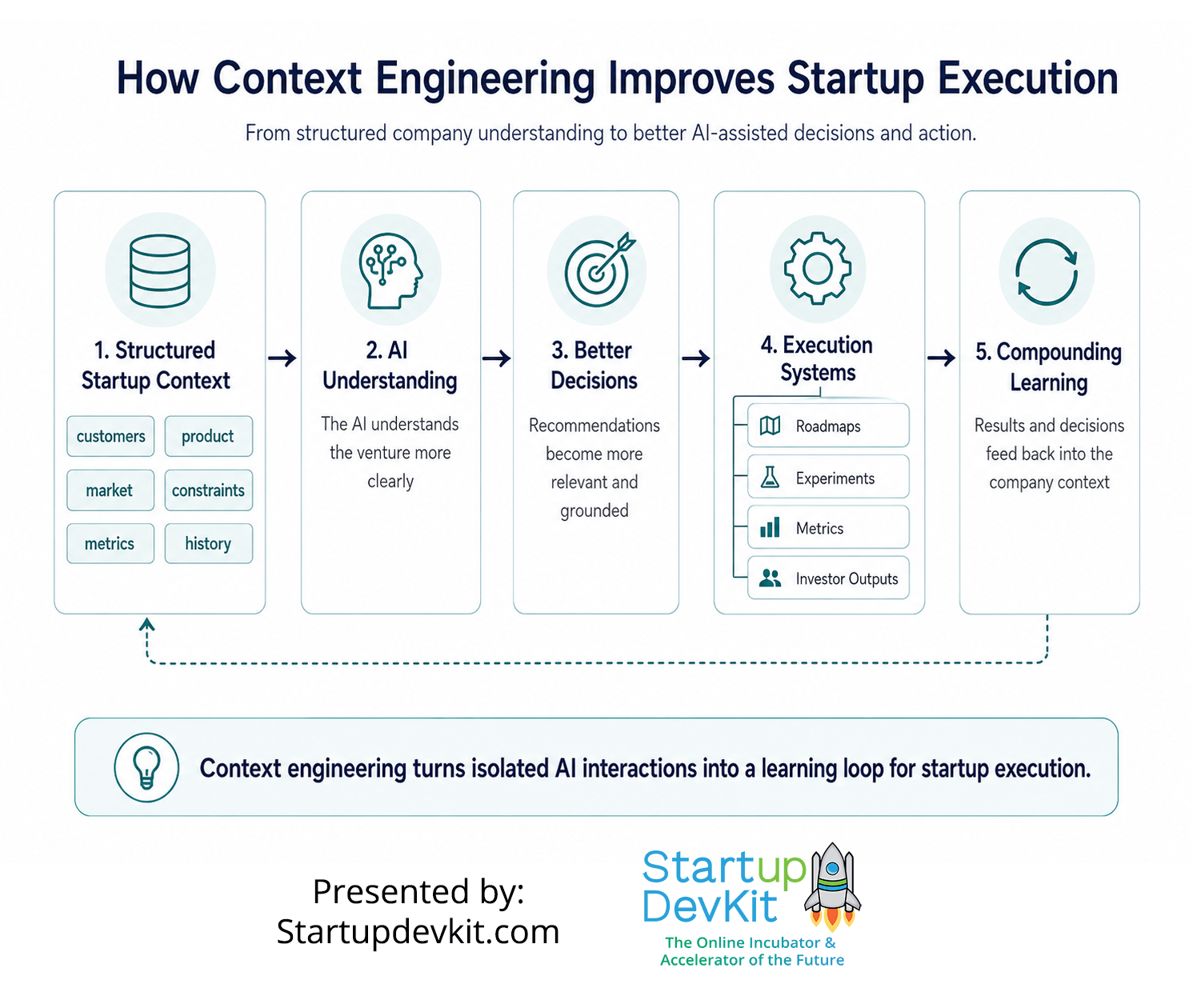
This creates a more persistent understanding of the venture.
StartupDevKit can then use that company context to support tasks such as:
- Developing and improving Venture Model inputs
- Generating stage-appropriate roadmaps
- Identifying priorities and constraints
- Recommending experiments
- Connecting execution to measurable outcomes
- Preserving learning across experiments
- Producing investor-ready outputs
The roadmaps translate the company’s structured context into prioritized actions across different time horizons.
The Experiment Hub extends that context into execution. Experiments can be connected to hypotheses, activities, metrics, success criteria, outcomes, and next actions. As founders execute and record results, the company develops a stronger body of evidence and learning.
This creates continuity between:
- Venture planning
- Strategic priorities
- Roadmaps
- Experiments
- Metrics
- Decisions
- Investor communication
The goal is not simply to generate more content. It is to help founders use AI within a structured system that reflects the venture they are actually building.
12. Frequently Asked Questions About Context Engineering
What Is Context Engineering?
Context engineering is the practice of organizing, maintaining, and providing the information an AI system needs to understand a situation and complete a task effectively.
What Is Business Context in AI?
Business context is the company-specific information an AI system may need, including the company’s customers, product, market, business model, resources, constraints, goals, evidence, history, and decisions.
How Is Context Engineering Different From Prompt Engineering?
Prompt engineering focuses on how instructions are written. Context engineering focuses on the information available when the AI follows those instructions.
What Is an Example of Context Engineering?
A founder asking AI to create a growth plan could provide the company’s stage, target customer, product, current conversion rates, budget, available time, previous channel tests, growth objective, and existing constraints. Organizing and supplying that information is an example of context engineering.
Can Context Engineering Improve AI Accuracy?
Context engineering can improve the relevance, consistency, and grounding of AI outputs. However, it does not guarantee that every statement will be correct. Important facts, calculations, and decisions should still be reviewed and verified.
Can Too Much Context Reduce AI Performance?
Yes. Large amounts of irrelevant, outdated, repetitive, or contradictory information can make it harder for an AI system to identify what matters.
What Information Should AI Know About a Company?
The answer depends on the task, but useful categories often include company information, customers, product, market, execution capacity, history, decisions, constraints, evidence, priorities, and communication standards.
How Often Should Business Context Be Updated?
Context should be updated whenever new evidence or decisions materially change the company’s understanding, priorities, strategy, resources, or performance.
Is Context Engineering Only Useful for AI Agents?
No. Context engineering can improve ordinary AI conversations, content generation, research, planning, decision support, internal knowledge systems, and AI agents.
Can Small Businesses Use Context Engineering?
Yes. Small businesses can begin with a structured company profile, customer information, documented decisions, operating constraints, communication standards, and current priorities.
How Can Startups Begin Using Context Engineering?
Start by creating a structured source of truth for the venture. Separate facts from assumptions, record experiments and decisions, document constraints, and update the information as the company learns.
Do Companies Need Special Context-Engineering Software?
No. A company can begin using documents, spreadsheets, databases, or knowledge-management tools. Specialized software becomes more useful when the company wants to connect structured context directly to planning, execution, AI assistance, and organizational learning.
Conclusion: Building Better AI Results With Better Context
The quality of AI-generated business advice depends on more than the intelligence of the model or the sophistication of the prompt.
AI needs context.
When an AI system understands the company, customers, product, market, constraints, evidence, history, and priorities, it can generate responses that are far more relevant to the work being performed.
Prompt engineering remains important because the AI still needs clear instructions. But even the best prompt cannot fully compensate for missing or poorly organized company knowledge.
The most effective approach combines both:
Rich context provides understanding. Structured prompts provide direction.
For startups, context engineering can become more than a method for improving individual AI responses. It can create a stronger system for planning, experimentation, decision-making, execution, knowledge management, and organizational learning.
The startups that build these systems early may not only use AI more effectively. They may also become better at understanding and operating their businesses.